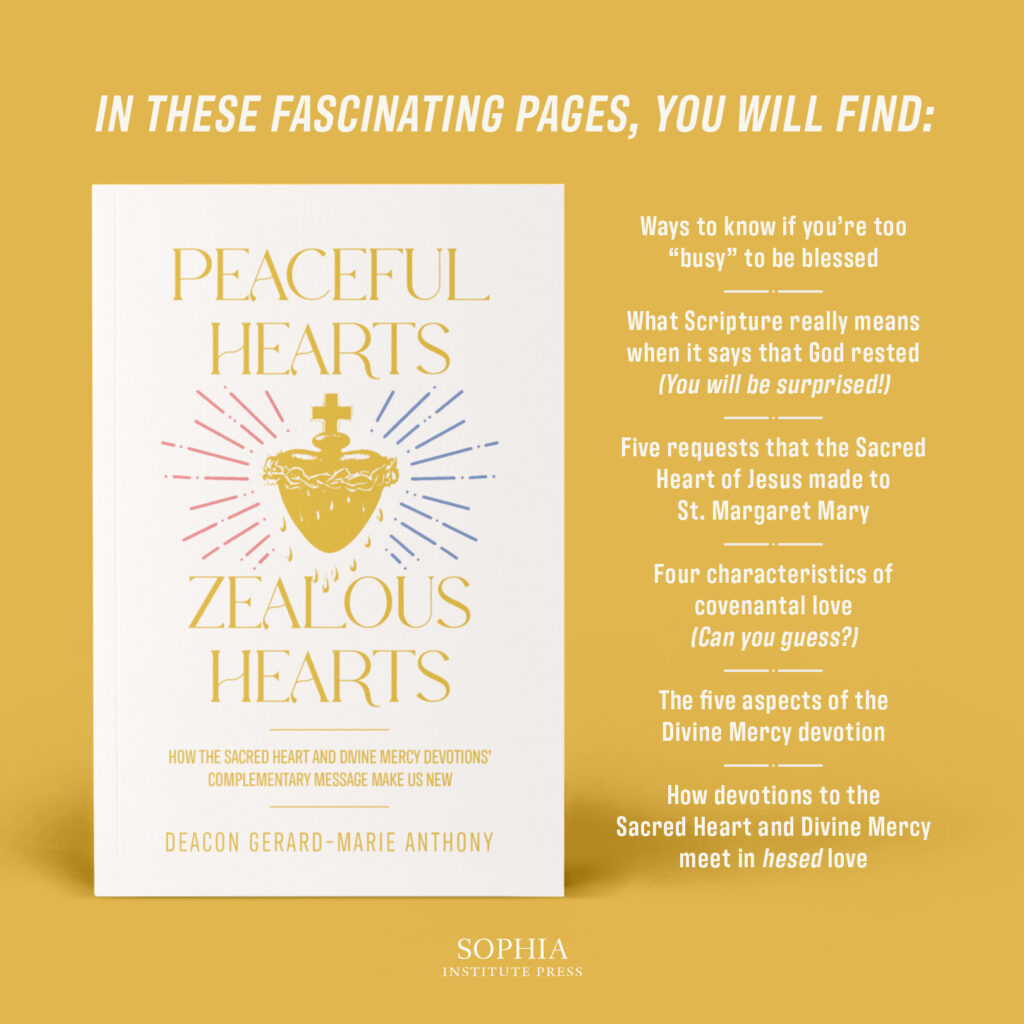
The following is an article by Deacon Gerard-Marie Anthony on his soon to be released book Peaceful Hearts, Zealous Hearts: How the Sacred Heart and Divine Mercy Devotion’ Complementary Messages Make Us New by Sophia Institute Press.
We often hear the phrase “a picture is worth a thousand words.” This phrase shows that a picture can capture the many different aspects of a specific point in time as compared to a single word. Now if this is the case for regular pictures, what could a picture of the Divine Word (see Jn. 1:1) illustrate? This is the great blessing of the images of Divine Mercy and the Sacred Heart of Jesus. In both images, there are the many aspects of God’s love as well as Divine promises which repeat the beauty of God’s hesed love.
So what is Hesed? It is a Hebrew term for covenantal love. It is not simply a fleeting emotion, a feeling, or even a strong friendship which people often think of equating to love. Hesed is covenantal meaning it is a perpetual exchange of persons. Perpetual means that it cannot be taken back. It is not temporary and does not end as most of our friendships and feelings do. It is an exchange of persons, not of tasks or things. It is not, “you do this for me, I’ll do that for you.” This is a contract. Instead, this is “I’m here for you and you are here for me.” We see this Hesed love beautifully in the image of the Divine Mercy.
First, we see the perpetual aspect of God’s hesed love in the touching of Jesus’s heart which blood and water come forth. Jesus touches his heart. Since Jesus is true God and true man as the Creed tells us; there is an eternal exchange of love. This also shows that when humanity takes the time to encounter the heart of God, rays of blessings are poured out upon them. Jesus touching His heart also shows God does not take back His promise of blessings. The rays represent these blessings, and they flow from His heart perpetually without end. Pope John Paul II tells us this in his address on Divine Mercy:
Saint Faustina saw, coming from this Heart that was overflowing with generous love, two rays of light that illuminated the world. “The two rays,” according to what Jesus Himself told her, “represent the blood and the water” (Diary, 299). The blood recalls the sacrifice of Golgotha, and the mystery of the Eucharist. The water, according to the rich symbolism of the Evangelist St. John, makes us think of Baptism and the Gift of the Holy Spirit (cf. Jn 3:5; 4:14). Through the mystery of this wounded Heart, the restorative tide of God’s merciful love continues to spread over the men and women of our time. Here alone can those who long for true and lasting happiness find its secret (Address on Divine Mercy, 2001, Sec. 5).
The Perpetual Aspect of God’s Hesed love help us to find the secret to true and lasting happiness! This secret flows from Jesus’ Sacred in the Sacraments. The Sacrament of Baptism is necessary for eternal life (see Mk. 16:16 and Jn. 3:3) and the Eucharist which is the new and everlasting covenant (Matt. 26:28). We also see that Jesus is walking towards us in the image, not away from us showing that He is perpetually interested in staying with us. Thus, He is focused on upholding the standard of Hesed Covenantal love.
Next, we see the exchange of persons instead of things in the image of Divine Mercy. Jesus raises his hand in the posture of blessing to show that when you do things out of love for Him (which are known as acts of mercy); He will bless you (and even your undertakings as promised to those who devote themselves to the image of the Sacred Heart). Jesus tells us this:
When the Son of man comes in his glory, and all the angels with him, then he will sit on his glorious throne. Then the King will say to those at his right hand, ‘Come, O blessed of my Father, inherit the kingdom prepared for you from the foundation of the world; for I was hungry and you gave me food, I was thirsty and you gave me drink, I was a stranger and you welcomed me, I was naked and you clothed me, I was sick and you visited me, I was in prison and you came to me.’ Then the righteous will answer him, ‘Lord, when did we see thee hungry and feed thee, or thirsty and give thee drink? And when did we see thee a stranger and welcome thee, or naked and clothe thee? And when did we see thee sick or in prison and visit thee?’ And the King will answer them, ‘Truly, I say to you, as you did it to one of the least of these my brethren, you did it to me (Matt. 25: 31, 34-40).
Jesus wants to bless not just our undertakings, but He wants to bless us!! This is the reason He looks at us in the image. He does not take His eyes off us, we are the “apple of his eye” (Deut. 32:10). Jesus also emphasizes the fact that He is not just loving us on the condition that we do this or that for Him. He tells us no matter what we do (of course He wants us to do good and avoid evil as He made us that way), He is with us. He tells us no matter how bad it looks; He will not abandon us. This is the reason He puts His signature at the bottom of the image “Jesus, I trust in You” so we would know He says we can trust Him. He signs His life away to us in the Divine Mercy Image and simply asks us to do the same so we can receive His blessings.
Thus, we see that this picture is worth more than a thousand words, it is worth one infinite Word, Jesus Christ and His Hesed love. This is a love which is faithful, enduring, and transformative. Whenever we look at this image, let us remember God’s Hesed love a thousand times over and take heart knowing that if we stay connected to His Sacred Heart, rays of Divine Mercy will flow out upon us. Then our lives will renew the Hesed love we are made for, and our hearts will beat to the rhythm of Divine Mercy proclaiming, “Jesus, I trust in you.”

Author Bio: Deacon Gerard-Marie Anthony
Dcn. Gerard-Marie Anthony is a deacon at Holy Trinity Catholic Church. He is a board member and helps run the Mother of Light Center which gives dignity to those who are going through various types of hardship in life. He also is a professor at the Catholic Bible School- Virginia as well as a scholar for Sophia Institute for Teachers. He has a book coming out on May 21st connecting the Sacred Heart of Jesus and Divine Mercy called Peaceful Hearts, Zealous Hearts. Pre-order or buy a copy of the book here: https://sophiainstitute.com/