

This is a lesson for which I will be forever in debt to Dr. Brant Pitre. He taught it to me, and I’m passing it on. But I have to say up front that if you enjoy this post, check out his presentation on it here. It is amazing stuff!
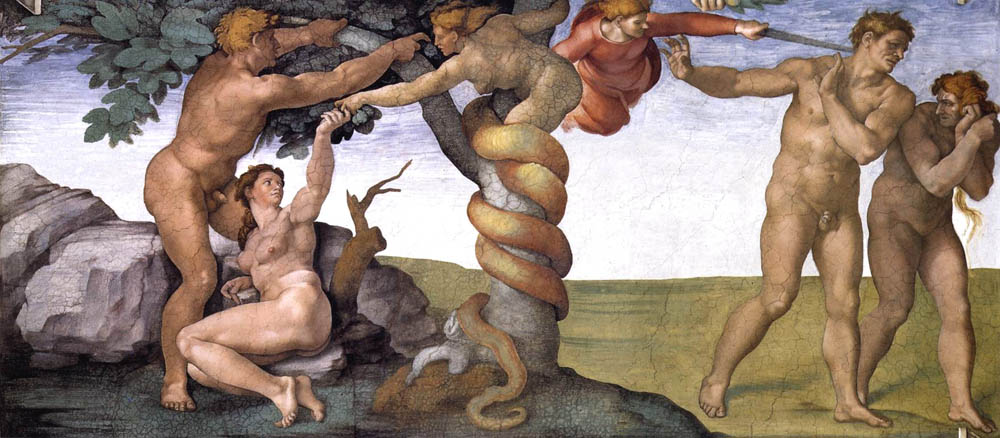
Lent is a fantastic spiritual opportunity for Catholics, and a mainstay in this season is to re-commit ourselves to prayer, fasting, and giving alms. But have you ever wondered where these practices come from? It all starts, like so many things, with Adam and Eve. They face a triple temptation from the serpent. Here’s how Eve rationalized the decision to give in:
“So when the woman saw that the tree was good for food, and that it was a delight to the eyes, and that the tree was to be desired to make one wise, she took of its fruit and ate; and she also gave some to her husband, and he ate.” (Gen. 3: 6)
What is described in a few short verses in Genesis takes on a more fully explored form in the Gospels, where we see three specific temptations of Jesus that line up with a different aspect of the threefold temptation of Adam and Eve.
Jesus, in the Sermon on the Mount, gives a sort of spiritual prescription to help overcome the three temptations Adam and Eve faced, and that we all face. The answer? Prayer, fasting, and alms giving. But there’s even more: the Church, in the witness of its religious (monks, nuns, brothers, and sisters) shows us what the life dedicated to overcoming these temptations looks like. It takes on the form of the evangelical counsels of poverty, chastity, and obedience. There’s a TON that could be said on this topic (see the link above for an example), but I decided to try to condense it into a chart for the sake of brevity.
What you hopefully will see is that the Lenten recommendations for Catholics to fast, pray, and give alms all correspond not only to the the common human experience of temptation, but actually go back and have their deepest roots in the experience of the first Adam. Furthermore, the second Adam, who experienced these temptations, shows us the solution, and that is the solution recommended by the Church for all of us during Lent and indeed during our spiritual life as a whole. Finally, the living out of this program of fasting, prayer, and alms-giving has its deepest expression in the vows made by monks and nuns.
So, check out the chart below, and notice that I’ve included some rough scripture citations to get you into the context. It’s a beautiful picture, one a student of mine described as a “spiritual jigsaw puzzle.” I hope this is helpful, especially in this format. It took me over an hour to present it in class when I tried going through each single detail, so I think this is a faster way to get the info. Again, please check out Dr. Pitre’s talk on this topic if this seems intriguing to you. It’s absolutely worth the cost (Less than $10 for the mp3!)
|
Sin of the Flesh |
Sin of the Eyes (Possessions) |
Sin of pride (or the pride of life, see 1 John 2) |
|
|
Adam and Eve’s Experience (Gn. 3:6) |
The fruit was “good for food.” |
The fruit was “pleasing to the eyes.” |
The fruit was desirable to make one wise (i.e. like God, the height of pride) |
|
Warning to Kings of Israel (Deut. 17: 16-17) |
Forbidden from having multiple wives. Solomon fails terribly in this regard. |
Not supposed to store up huge gold reserves. Solomon again fails (with 666 talents of gold). |
Prohibitted from having lots of horses (i.e. a large army). Solomon…three strikes! (See 1 Kings 10-11) |
|
Jesus’ experience (Mt. 3, Mk. 1, Lk. 4) |
Tempted to turn stone into bread, responds “Man does not live on bread alone.” |
Jesus is shown, visually, all the kingdoms of the earth, and offered a sort of temporal possession of it, if he will serve Satan. He responds “You shall serve the Lord alone.” |
Jesus tempted to display his divinity to convince the people he is God. Satan says God will send angels to protect him if he throws himself from the Temple. Jesus responds “You shall not tempt the Lord, your God.” |
|
Jesus’ solution (Mt. 6) |
Fasting: it combats the body’s desires and helps us to strengthen our will, to order our natural passions. (Mt. 6: 16-18) |
Almsgiving: fights the temptation to possess or to have power by doing the very opposite: giving away our material goods. (Mt. 6: 1-4) |
Prayer: Counters the temptation to pride, because prayer requires humility and recognizing that we are mere servants, not God. (Mt. 6: 5-15) |
|
Vows of Religious Life |
Chastity, fights the temptation to lust. |
Poverty: a life-long giving of alms, which helps to avoid attachment to material goods. |
Obedience: helps to overcome pride, and opens one up to the life of humility necessary for a good prayer life. |
Pax,
Luke





2 thoughts on “Why Do We Pray, Fast, and Give Alms During Lent?”
Pingback: FRIDAY EDITION - BigPulpit.com
Pingback: Tuesday, March 10, 2015 | Gus Lloyd's Reflections