
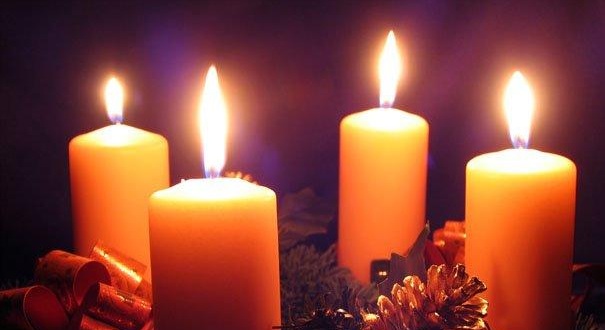
“A voice cries out: In the desert prepare the way of the LORD! Make straight in the wasteland a highway for our God! Every valley shall be filled in, every mountain and hill shall be made low; The rugged land shall be made a plain, the rough country, a broad valley. Then the glory of the LORD shall be revealed, and all mankind shall see it together; for the mouth of the LORD has spoken. ” (Isaiah 40:3-5)
Advent is upon us, and so we should be in a state of preparation and anticipation. Outwardly, this may be preparation for Christmas, which parallels our inner preparations for the coming of Christ. In what sense do we prepare for Christ’s coming—or in what sense is Christ coming to us?
Blessed Jacobus de Voragine, a thirteenth century Dominican friar and later bishop, wrote of advent that
“The Lord’s advent is celebrated for four weeks to signify that his coming is fourfold: he came to us in the flesh, he comes into our hearts, he comes to us at death, and he will come to judge us. The fourth week is seldom completed because the glory of the saints, which will be bestowed at the last coming, will never end….While the Lord’s comings are four, the Church specially memorializes two of them, the one in the flesh and the one at the Last Judgement. Therefore the Advent fast is partly one of rejoicing, by reason of Christ’s coming in the flesh, and partly one of anxiety at the thought of the Judgment.”
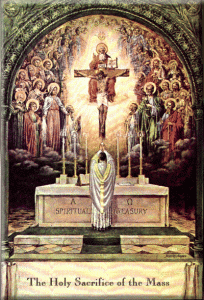
It occurs to me that in light of this double-emphasis—the Lord’s coming in the flesh and His coming in Judgment—that the Mass itself is a sort of miniature advent. Certainly, the Mass has been compared to the end of times (well, to the Book of Revelations), and might be said to be the Church’s own interpretation of that work. Further we do believe that in the Eucharist, the substances of bread and wine are transformed into the Body, Blood, Soul and Divinity of our Lord, so that when we receive Communion Christ is coming to us in the flesh.
Therefore, the Mass leading up to Communion shows us what we might do during Advent to prepare us for the Lord’s coming:
- Fasting
- Prayer
- Studying Scripture
- Studying particular moments in the life of Christ or particular teachings of Christ
- Studying the lives of the saints and the Church
- Listening to the writings of those wise in the faith
Let’s briefly consider each of these in turn.
Fasting
Fasting was once a regular part of Advent, just as in Lent. For that matter, the Church was previously more strict about fasting before receiving Communion: we now have an hour-long fast, whereas there was a time when the length of the fast was three hours, and before that from midnight until Mass (hence the popularity of early-morning Mass). We might her fast in the literal sense (that is, from food) or the more figurative sense of giving up something for Advent (much as in Lent). If we abstain from a particular regular food (like coffee) on which we spend money, the money saved can be donated to the poor. Indeed, most parishes have a giving tree which requests some particular gift for some particular family.
In this way, we can identify our small sacrifices with Christ’s one great sacrifice, and also we can use whatever mild suffering comes from these small deprivations to alleviate the greater suffering of the poor. We must be ever-mindful of Christ’s description of the Judgment Day in His parable of the sheep and the goats (Matthew 25:31-46): whatever we do for the least of His people we do for Him, and conversely whatever we don’t do for them, we don’t do for Him.
Prayer
Depending on how you want to slice it, the Mass is either one long prayer or several shorter prayers connected together. Maybe it would be better say that the Mass is a single long prayer composed of several shorter ones, each of which builds on the previous. We might, in the context of Advent, be most drawn to certain prayers (or parts of prayers) in the Mass: “Lead us not into temptation, but deliver us from evil” and perhaps “Lord, I am not worthy that you should enter under my roof, but only say the word and my soul shall be healed.” These are most obviously said in preparation for encountering the Lord as Judge and as Savior. Or again, during the penitential rites we ask the Lord to have mercy on us and to forgive our sins; and for that matter for the other members of the parish to pray for us. On the other hand, the Gloria and the Sanctus are pulled from the book of Revelations directly, and so are associated with Christ in heaven and in His glorious second coming.
Scripture
The Mass itself is of course replete with Scripture references (I have already noted a few of them). The most obvious use of Scripture, however, is in the Liturgy of the Word. Every Sunday, we hear one passage from the Old Testament, one from the New Testament letters, one from the Gospels, and one from the Psalms [1]. I’ve found that I get more from the readings if I’ve read the m beforehand and then can listen and read along (baby permitting) during the Mass with the verse already somewhat fresh in my mind—and in my heart. This portion of the Mass perhaps relates most neatly to the second sense in which Christ comes to us, which is into our hearts.
The Scriptures contain the Word of the Lord, and not merely His words. When we encounter them, we are invited not only to read them, and not only to study them, but to accept them, to meditate on them, to contemplate them, and finally to take them into ourselves. They enter our minds through reading and study, but then our hearts through prayer and contemplation—and we prepare the way for the Lord to do the same in meditating on these Scriptures.
Life of Christ and the Saints
In the Gospel reading in particular we are given a glimpse of the life of Christ. However, the Church also has liturgical seasons and special feasts which focus again on particular moments in the life of Christ or on particular doctrines about Him and aspects of Him.
We similarly see particular days in which the Church focuses on Christ’s greatest followers (the saints) or on His Church as a whole. Within the Mass itself, this is typically seen especially in the Collects. We hope to imitate Christ, or as St Paul puts it, to “clothe [ourselves] in Christ” (Galatians 3:27). The saints in turn give us a variety of example as to how to do that.
“And do this because you know the time; it is the hour now for you to awake from sleep. For our salvation is nearer now than when we first believed; the night is advanced, the day is at hand. Let us then throw off the works of darkness [and] put on the armor of light; let us conduct ourselves properly as in the day,not in orgies and drunkenness, not in promiscuity and licentiousness, not in rivalry and jealousy. But put on the Lord Jesus Christ, and make no provision for the desires of the flesh” (Romans 13:11-14).
Other writings
Finally, we should listen to the writings and teachings of those who are wise in the faith. In the Mass, the Homily and/or sermons fill this role. The theme running through the days’ readings is fleshed out for us by the priest in the Mass, and then ideally some exhortation is given to the moral, virtuous, and above all holy (Christ-like) life. Outside of the Mass, we have the writings of the Church Father and Doctors, of the saints, and for that matter of faithful and learned instructors like Fulton Sheen and G.K. Chesteron [2], or C.S. Lewis [3], or the Holy Father [4] and our bishops.
Advent is a time of preparation for the reception of the Lord—in the flesh–into our hearts, at the end of our lives, and in the Last Judgment. This preparation should be with us year-round, since we know neither the day nor the hour when Christ will come to us (Matthew 25:13), though we are especially reminded of this preparation during the liturgical season. Thanks to the Mass, we do indeed spend time year-round preparing the way for the Lord. And in looking at the Mass, we see some ways in which we can prepare for the Lord’s coming to us.
—Footnotes—
[1] Your mileage may vary with liturgical season, of course. And during a daily Mass this becomes one from either the Old or New Testament (non-Gospel), one Psalm (responsory), and one passage from the Gospels.
[2] Both of who may yet be canonized saints some day
[3] We can learn something from non-Catholics, too.
[4] Whether Pope Francis or Pope Benedict XVI or Pope John Paul II or… I would especially recommend such documents as encyclicals or apostolic exhortations into which generally goes much thought and preparation.



1 thought on “Advent in Miniature”
Pingback: Hope in Season - IgnitumToday : IgnitumToday