
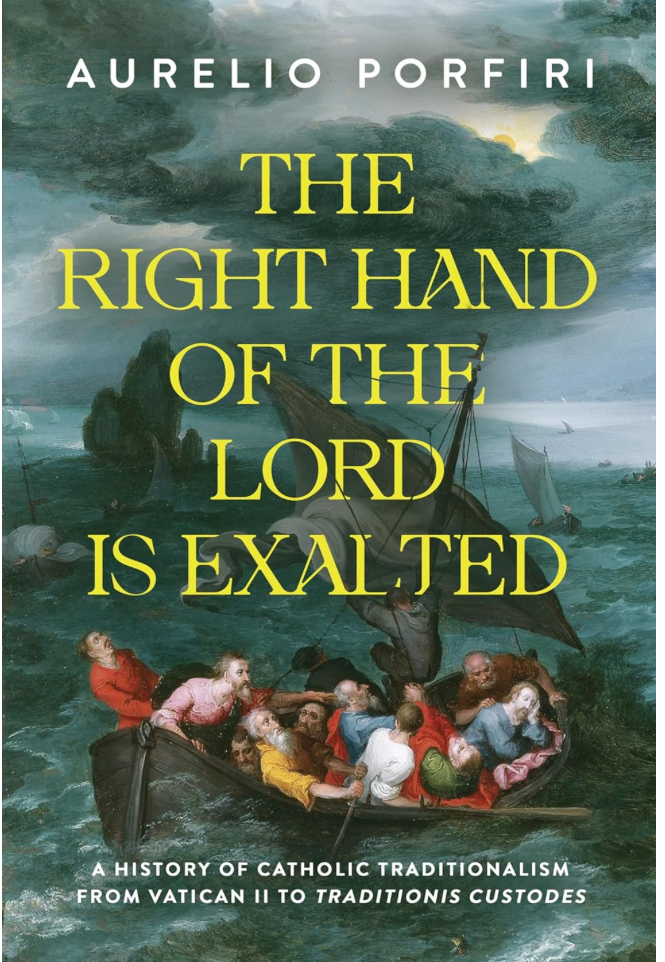
During the research for my book The Right Hand of the Lord is Exalted: A History of Catholic Traditionalism from Vatican II to Traditionis Custodes (Sophia Institute Press), I realized that many young people today are rediscovering Tradition. What does this rediscovery mean? It signifies that Tradition is not something for the old or the eccentric, as some would have us believe, but is a visible and tangible sign of the Church’s perennial youthfulness—a youthfulness that Tradition invigorates and is, in turn, invigorated by.
It seems necessary, therefore, to identify three reasons why many young people today are rediscovering Tradition, not to become “traditionalists” but to rediscover themselves as “traditional.”
1) Tradition is Beauty. Tradition is primordial and originating beauty. It reflects that primal beauty which is God, Splendor Paternae Gloriae, the splendor of the Father’s glory. Tradition loves beauty and promotes it in all fields, from music to architecture, from prayer to the visual arts. Young people, with their great capacity for enthusiasm typical of their age, feel deeply moved when they come into contact with true beauty and experience a joy I would not hesitate to call ecstatic. The great Italian writer Umberto Eco stated: “In the ecstatic moment the soul is expanded, uplifted by the beauty it perceives, entirely lost in the object” (Art and Beauty in Medieval Aesthetics). Young people are tired of the tyranny of the functional and the simplified and want to drink again from pure sources; Italian philosopher Marcello Veneziani says in this regard: “We have considered beauty a dead language, like Latin and Greek, leaving the monopoly of life to utility, which is then the extreme offspring of instrumental reason” (Letter to Italians). Young people are rediscovering those venerable rites in which gestures are measured like dance steps, the beauty of liturgical chants that are not a poor imitation of commercial music, and the doctrine that the Church has always guarded as a precious treasure.
2) Tradition is Fullness of Meaning. The world makes a lot of noise, and not just because of wars. They want us to believe that there are new dogmas, no longer those proclaimed by God but those imposed by those who now can move the destinies of humanity, trying to dislodge God from His throne. But all this, when looked at more closely, shows its profound inconsistency. Young people need fullness of meaning, to give significance to the life that lies ahead of them. Tradition is this fullness of meaning; Tradition allows the world to be sanctified. This statement by the great Brazilian Catholic thinker Plinio Corrêa de Oliveira seems particularly apt for young people: “‘I want more, I want more, I want more!’ is the continuous longing of the Catholic soul. Not only do I want more, but I want everything. And because I want everything, I find it in nothing, but my reason shows me that it exists beyond and infinitely. This is the possibility of enjoying things without frustration! Indeed, they please us at first, but then disappoint. Nonetheless, they contain an announcement, a promise, and a foretaste; only then can we truly live.” The Catholic wants everything, as the French philosopher Jean Guitton, a friend of Popes, who also inspired the apologetic work of the great Italian writer Vittorio Messori, also said. Young people thirst for meaning, but unfortunately, today even religion seems to create questions but not have answers. Tradition is the answer, and young people know this.
3) Tradition is Continuity. Tradition, by definition, is continuity. Many young people have understood that their age is not an absolute but a moment of passage, and Tradition is a sign of this flow from origin to fulfillment. Youthfulness, unfortunately also promoted within the Church, where youth is separated from the flow of life, has miserably failed. Many young people feel that the age they are living is a preparation for maturity, and Tradition is a sure guide in this because it possesses the pedagogy of the ages. Young people need to feel they are children of a civilization. Marcello Veneziani, in the aforementioned work, makes this observation: “Civilization recognizes a threshold, a boundary, and a hedge; it is never limitless and formless. Civilization should not be confused with ‘civilization’ in the technical sense, which pertains to the sphere of means. Civilization transcends utility and does not exhaust itself in the functional because it is founded on the love of beauty, order, and harmony, which is the daughter of the first two. Those who think that the ultimate and unsurpassable stage of a civilization is the global market combined with planetary technology have already abdicated civilization: they confuse the sun with solar panels. Civilization is a vision of the world, not a visualization on a tablet.” Hence, digital natives now feel the need to be analog, to rediscover themselves as part of a network that extends through space and time, not just children of history, but children of the eternal.
Author Bio: Aurelio Porfiri
Aurelio Porfiri is a composer, conductor, organist, writer, teacher and entepreneur. After living for 7 years in Macau (China) is now based again in his hometown, Rome (Italy). He is author of over 60 books, translated in multiple languages.





1 thought on “Three Reasons Why Many Young People Are Rediscovering Tradition”
As a 73 year old Boomer, I have had direct experience with pre and post VII rights. I can state that the change from passive, devotional, no participation pre rubrics to Ordinary Form was so very uplifting, engaging and personally sacred to we youngsters first experiencing the change. It was pure beauty in action. While early music simplicity was crude, soon came wonderful four part harmony hymns like the Magnificat. May I suggest that it is simply “change” that drives the young generation, just as it drove mine? Kids look to be different than parents. To me the real key is what is the outcome the church expects? We were told we lost engagement in Mass and needed it back. That rubrics had become too formal