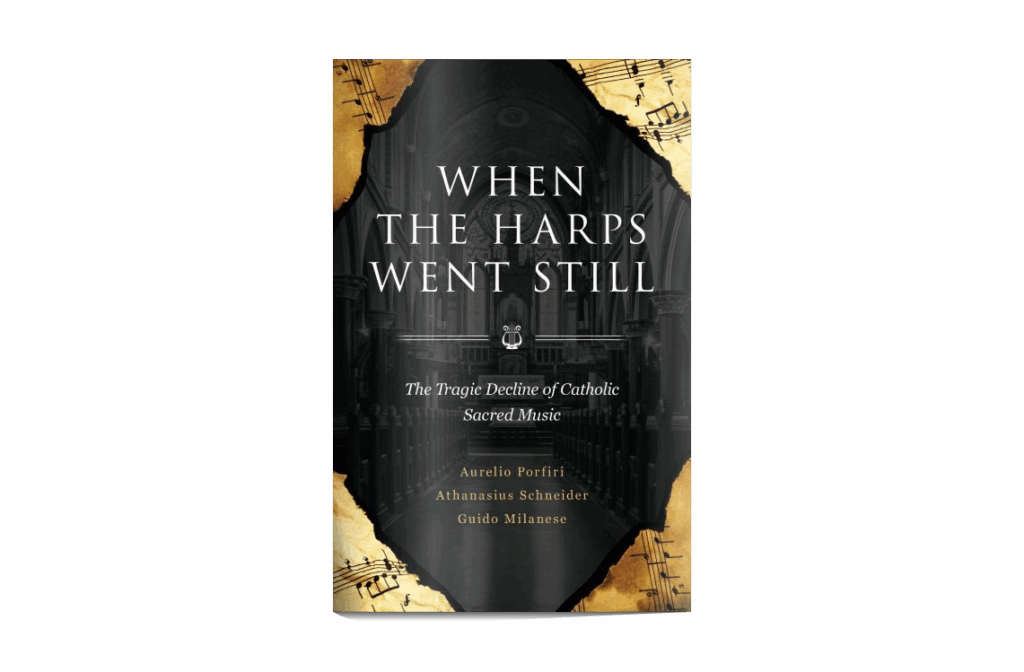
When the Harps Went Still by Aurelio Porfiri, Bishop Athanasius Schneider, and Guido Milanese. Sophia Institute Press (Manchester, NH, 2025). 176 pp.,paperback. $18.95.
Maybe this has happened to you, whether when traveling or attending a special Mass, or shockingly, even at your own parish. As you prepare to enter into the silence of the sacred liturgy, sonically annoying noise–I mean music–peels over the sound system, and you are barraged with bohemian strains when you were just hoping to worship the Lord.
How did sacred music evolve to this point? Is there anything that we can do to reverse the course?
Tragically, we’ve all seen firsthand how misinterpretation of theology and concessions to popular culture have impacted the choices of music we’re too often subjected to at Holy Mass.
In When the Harps Went Still, composer and conductor Aurelio Porfiri, defender of the faith Bishop Athanasius Schneider, and renowned scholar Guido Milanese, a leader of a sacred vocal ensemble, guide readers in discovering the history of sacred music from the Old Testament to Gregorian Chant, and the need for its incorporation in the liturgy today.
In a recent interview with The Catholic Register, Porfiri said, “The music is a kind of double-edged sword — a double power. Music that is appropriate can help us to elevate ourselves and make us closer to the divine, but the not appropriate music can (cause) the opposite effect. So that really is a kind of miseducation to the beauty of liturgy, to the beauty of sacred music and to the beauty of the tradition that we inherit from our ancestors.”
In these enlightening pages, readers will learn about the meaning and history of sacred music, and find ways to renew our rich spiritual and cultural heritage, and reclaim the continuity of sacred teaching through sacred music.
Porfiri added, “What we can say about the historical element is that we as Catholics have to be very proud because the music of the Church is at the foundation of all the history of Western music. All the things that we like (at) concerts, symphonies, sonatas, concertos or whatever you want to call it, opera, all of this develop from sacred music, develop from our tradition.”
Robert Fastiggi, Ph.D., Professor of Dogmatic Theology, Sacred Heart Major Seminary, said, “Although Vatican II’s constitution Sacrosanctum Concilium praised the musical tradition of the universal Church as ‘a treasure of inestimable value,’ the decades following the Council brought about a lamentable decline in sacred music. The authors examine the theological, liturgical, and cultural reasons for this decline, and they explain what is needed to bring about a revival of sacred music directed to the elevation of souls.”
Afterall, worshipping the Lord with sacred music in the liturgy offers us a foretaste of Heaven. God has created us to share in the joy of His loving presence.
Members of the media may send an email to Sophia Institute Press’ Director of Publicity, Sarah Lemieux at slemieux@SophiaInstitute.com to receive a physical or digital copy of When the Harps Went Still and/or to schedule an interview with Aurelio Porfiri.