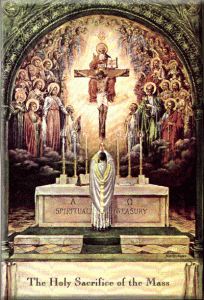
When Jesus was being arrested at the beginning of His Passion, He made it clear that He could have asked His Father to “send me more than twelve legions of angels” that would protect Him. Yet He didn’t; He had to allow this to happen to fulfill His Father’s will (Matthew 26:53-54). The story of St. Tatiana of Rome, whose feast was on January 12, can be read as proof that this was true.
Tatiana was a deaconess in the third century — and, as a reminder, there was indeed a ministry for women in the early church that was at least quasi-sacramental and was seen as directly analogous, though not identical, to that of male deacons. Chapter 16 of the Didascalia describes the functions of a deaconess, which included baptism and chrismation. This may be something for those of you freaking out over female lectors and acolytes to keep in mind.
In any event, Tatiana was the daughter of a civil servant who was secretly a Christian and privately brought her up in the Faith. However, being a deaconess and ministering to the poor and sick in that capacity attracted the attention of Ulpian, the jurist who effectively yielded power in Rome while the emperor, Alexander Severus, was underage.
Ulpian was considered one of the great legal minds of his age, an expert systematizer, codifier, and commentator of the law (about a third of Justinian’s Digest comes from him, including the first ever actuarial life table). He was known for making sagely remarks, like the descriptive phrase “juris praecepta sunt haec: honeste vivere, alterum non laedere, suum cuique tribuere” (“the precepts of justice are: to live honestly, to not harm others, and to render each his due”).
Yet, for all this, he was also a rabid anti-Christian, who codified anti-Christian legislation to make it easier for judges to apply it against believers. This is a good reminder that even wise and prudent thinkers with a strong sense of justice and rationality are perfectly capable of turning all of those faculties against Christianity, particularly if they see it as a threat to the social order.
Ulpian had Tatiana arrested and tried to force her to sacrifice to the idol of Apollo. Instead, she prayed to her God, Who caused an earthquake that not only destroyed the idol but, in a Samson-like moment, caused the entire temple to collapse, killing the priests and many of the worshipers. Some bystanders reportedly saw the shadow of fleeing demons, the beginning of the visible supernatural activity surrounding her martyrdom.
After this, the story goes, the attempted torture and executions of Tatiana began. First, her eyes were ripped out with hooks; she responded by praying, like Elisha (2 Kings 6:17), that her captors’ eyes would be opened. Sure enough, suddenly four angels appeared around her who began beating her torturers off. Eight witnesses to this were so affected that they fell to their knees before Tatiana professing Christ, for which they were all executed.
The following day, her eyes had been healed. This so frustrated her captors that they proceeded to torture her and slash her with blades for the next several days; each time angels appeared to redirect the force of the blows back against her torturers until they got exhausted and in some cases died.
Every time, she would return the next morning with her wounds completely healed, even having her breasts restored to her after they were cut off. They also kept trying to get her to sacrifice to idols that kept shattering. Famously, they threw her to lions, who refused to attack her and instead nestled lovingly at her feet.
Ultimately, she was beheaded, and this finally put an end to this ordeal. But, obviously, it isn’t that beheading “worked” where no other methods did, like beheading had some magic the other techniques didn’t. To me, the point of this story (however historical all the details are) is that God was making it clear that His saints only lose their life because He chooses to let it happen. If He had wanted to, He could have had His angels break the sword the moment it touched her neck.
What all those dramatic interventions before she finally died were effectively saying was: “You can’t take My daughter’s life by force. Her life and death is in My hands, and, if she does die, it’s because I chose to take her, not because you have any power.” Just as Jesus had said, if God wants, He can send armies of angels to protect us — and He probably does this a lot more often than we realize. Such misfortunes as seem to befall us are only allowed because of His loving plan for us. In that way, a strange story like Tatiana’s is a kind of theodicy.
Finally, we should remember that, because the empress of Russia opened that nation’s first university on Tatiana’s feast day, she is also the patron saint of students, and her feast day is commemorated as Students Day in Russia and her former colonies. So, if you’re trying to study and you feel like ripping out your own eyes in frustration, you may want to ask Tatiana for her intercession.
On a more serious note, Tatiana was beheaded alongside her father, who had risked and finally lost his life to make sure she was brought up a Christian. Maybe that’s another reason she’s a patron of students: Because we should all ask God to bring people into our lives who will teach and model for us how to be faithful and loving. Maybe, like Tatiana, having those kinds of teachers will help us to become saints.
___
Image: St. Tatiana of Rome / PD-US