
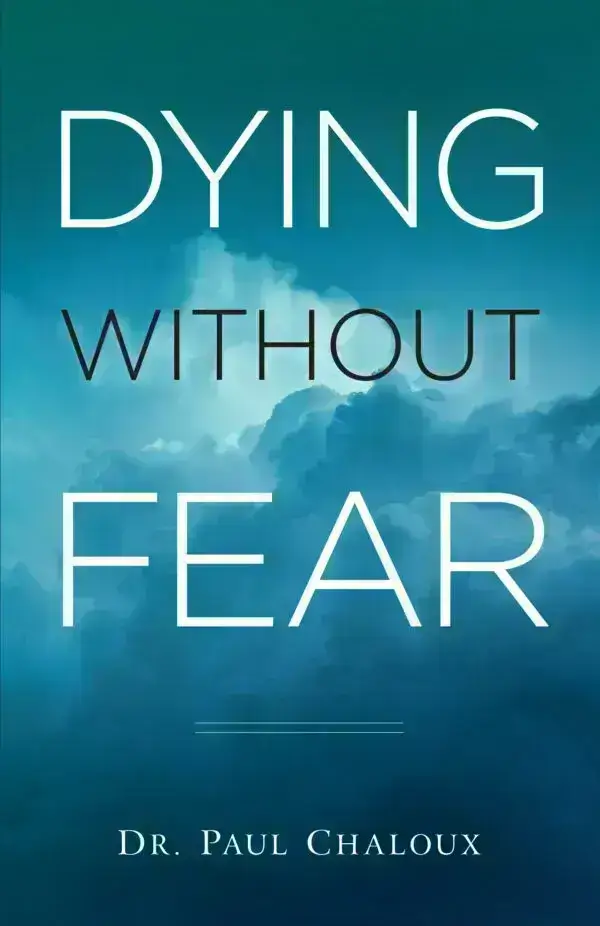
We are pleased to share an excerpt from Sophia Institute Press entitled “Dying without Fear” by Dr. Paul Chaloux.
Everyone suffers in life and everyone dies. People who read a book on suffering and death are not questioning that, nor are they questioning the existence of God. True atheists would never search for the meaning behind suffering and death because for there to be meaning behind these experiences then there would need to be a plan and a planner, which would mean a god. What a suffering or dying person wants to know is why this is happening at this particular time and in this particular manner and what is going to happen next. Many people suffering from a terminal injury or illness, or witnessing the loss of a loved one, will wonder whether God is punishing them or has abandoned them in their time of need. Although suffering and death are theologically the result of the great moral evil that was our first parents’ rebellion against God’s will (aka the “Fall of Man”), this book will show definitively that suffering and can be used by a loving and merciful God to bring us to eternal joy.
I am writing this particular book (Dying without Fear) because terminal suffering is a huge challenge for people and I understand dying much better than I did when I wrote Why All People Suffer. This understanding comes from thoughts from my students at the Avila Institute, several of whom worked with the dying, coupled with my own degradation from Parkinson’s Disease and the death of my mother Dolores (Dolly) Chaloux on May 8,2022 (fittingly, it was Mothers’ Day) after a long battle with dementia.
Dying without Fear is written in three sections. The first section covers the theology of suffering and death, explaining how Catholic Theology shows the love of God for us in preparing us to share both His nature and His Life with us in eternal joy. The second section of the book focuses us on how to interpret this theology and use it when you are terminally injured or terminally ill to prioritize how you spend your remaining time, energy, and resources to die well. The third section of the book is for caregivers and discusses how to properly care for the dying and how to come to understand a loved one’s death in God’s plan. You will note that I make ample use of my own family history to explain these points. These true family stories serve to illustrate the points, giving plausible positive effects of deaths looking back with the benefit of hindsight that hopefully many readers can relate to. These stories also help readers understand the genesis of my journey.
Writing these two books was unexpected but cathartic to do as I contemplated my life journey and studied what the church had to say about it. What I found out gave me solace in my suffering and the courage to face the real possibility of death without fear. My belief is that what I learned is truth and will benefit others, so I am sharing it through these two books, which are grounded in Church teaching, my own experiences and those of immediate family members going back three generations.
Suffering has a way of turning a person inward, toward where God resides. I know that God takes no delight in human discomfort, but I see now that it is unavoidable when breaking humans of the vices with which we have become comfortable, in order to set us firmly on the path to redemption. I have also come to understand that God must truly love us if He puts this much effort into keeping us on the path to joy. This is, after all, the same God that Jesus portrayed as the father, who waits anxiously for the prodigal son to return, not concerned by how he lived his life but overjoyed that he was coming home. We should not be surprised if God celebrates and throws a party for each of us who seeks to join with him in his eternal Kingdom, just as he did for the prodigal son in Jesus’ parable. (Luke 15: 11-32). With this in mind, it is possible for us to die without fear, secure in the knowledge that God loves us and if we are willing to follow him, an eternity of joy awaits us.
I say to all who may happen to read this: God has a plan for you and even if you cannot see where it is going, trust Him and follow where He leads you. It will be a remarkable journey and you will not regret it.
Author Bio – Dr. Paul Chaloux
Dr. Paul Chaloux was born in Maine in 1960 to Paul and Dolly Chaloux, the oldest of 6 children. He grew up in Northern Virginia and attended public schools. After graduating with a chemical engineering degree from the University of Virginia in 1982, Paul worked for over 30 years as an engineer, manager, and strategist for IBM in upstate New York. While there, he also served as a catechist for 15 years at St. Columba Parish in Hopewell Junction, NY. In 2015, after earning a master’s degree in religious education from Fordham University and retiring from IBM, Paul was accepted into the PhD program at the Catholic University of America to study Catechetics, with the goal of teaching future catechists. However, his plans changed dramatically when he was diagnosed with early onset Parkinson’s Disease just after moving to Washington, DC for his studies. His new neurologist, after learning that Paul was studying theology, asked him why people suffer. He had no answer since it was not his intended field of study, but the question intrigued him enough to cause him to take up the subject. Five years later, having earned his PhD in moral theology, Dr. Chaloux wrote Why We Suffer for general audiences as a follow on to his dissertation, The Grace Concealed in Suffering: Developing Virtue and Beatitude, which he defended at CUA on March 5, 2020. Dr. Chaloux currently teaches theology as an adjunct professor at the Catholic University of America and serves as a catechist at St. Agnes Parish in Arlington, Virginia. He has been married for over thirty years to his wife Sue and they have 4 adult children and 3 granddaughters.




1 thought on “Dying without Fear”
I really appreciate how Dr. Chaloux writes from his own experience. This isn’t simply another theology or self-help book. It deals with the issues real people face every day with regard to suffering, death, and grief. It is must read for everyone!