“…becoming a saint isn’t easy…just ask John Duns Scotus. Duns Scotus was a Scottish Franciscan priest and philosopher from the late 1200s. He was a profound writer, so profound that he acquired the nickname “The Subtle Doctor” (read: difficult to understand!). He was a highly sought-after preacher and teacher, teaching at some of the finest universities such as Paris and Cologne. He wrote rich theological texts which are still being studied today. Tragically, while teaching in Cologne, he was struck with a mysterious illness and fell into a coma and died.
Nevertheless, his holy reputation outlived him, and the Franciscans began to venerate him as a saint. Problem was – Rome wasn’t all that interested in his life. The Pope didn’t get around to looking at his life and writings until seven hundred years after his death – and he was finally beatified (named a “Blessed”) in 1993 by Pope John Paul II. Talk about a waiting period!
How does someone become a saint? There are six steps in that process.
First, a person has to be dead for five years. This sounds rather obvious, but the Church cannot canonize (officially declare a person to be a saint) unless they are dead – because by definition, a saint is someone who is in Heaven! (All human beings in Heaven are saints – most of whom we do not know their name. Perhaps your grandparents or great-grandparents are among those unknown saints!). So a “living saint” is somewhat of an oxymoron. When the Church declares someone a saint, this is an infallible declaration that they are in Heaven – so the Church needs to be absolutely sure that they are actually there! The five-year waiting period allows the initial fervor and grief and strong emotion, which might happen after a holy person dies, to subside, so that the Church can look objectively at the person’s life (this wait can be waived under certain circumstances, such as in the case of Pope John Paul II).
Then, the cause for canonization is opened. In other words, the local Bishop decides that a person who lived and died is worthy of a deeper investigation into their life. The Bishop will appoint a person called the postulator of the cause (usually a priest) who is in charge of gathering documents about the deceased person. Everything they ever wrote, interviews with people who knew them, records of people who are praying to them (and any miracles that may be associated with their intercession), are all gathered together and investigated on a local level. Often this cause for canonization requires the body to be exhumed and examined (which has proven useful on several occasions: some saints such as St. Rita of Cascia, are gifted with incorruptibility – their bodies have never decomposed. At the same time, when they opened the casket of the great spiritual writer Thomas a Kempis, preparing to canonize him, they noticed that there were scratch marks on the top of the coffin – he had accidentally been buried alive, and hence could not be canonized as they did not know if he may have cursed God while in the grave!)
If the Bishop sees enough evidence that they lived a life of genuine holiness and heroic virtue, and that people are beginning to have a devotion to this person, they are named a Servant of God. (As an aside, I met an American “Servant of God” while she was alive – Servant of God Gwen Coniker, a heroic mother of 12 children from Ohio who, with her husband, founded a Catholic organization called “Apostolate for Family Consecration” [www.afc.org – I highly recommend this organization and the week-long family retreats that they sponsor during the summers!]. Gwen was named Servant of God in 2007).
The investigation then goes from the local diocese to the Vatican, where a Congregation for Saints examines the cause. This renewed round of scrutiny includes further interviews, prayer, and discussion with the Holy Father. From the 1500s to 1983, there was even an official position in the Vatican called “Devil’s Advocate”, whose job it was to argue against the canonization of a person! Nevertheless, if a person’s life is judged to be heroic and holy, they are named Venerable. This allows the universal church to begin having a devotion to this person.
But they’re not done yet! They then need to perform two posthumous miracles to be named a saint. These miracles must be verified by medical doctors and have no scientific explanation. For example, in Mother Teresa’s case, a woman in India who was dying of a large abdominal tumor asked that a relic of Mother Teresa’s hair be placed upon her tumor. Mother Teresa’s nuns complied, and prayed through Mother’s intercession that this woman would be cured. The next day, the tumor had completely disappeared and all doctors could not discover any scientific remedy. Pope John Paul II likewise performed a posthumous miracle – a nun in France who was suffering from Parkinson’s Disease (the incurable disease that took the life of the late Pope) prayed for JPII’s intercession, and was inexplicably cured of the incurable disease.
Martyrs do not need to perform a posthumous miracle, as they made the ultimate sacrifice for Christ.
One miracle leads to the Beatification (naming someone a Blessed) and the second miracle leads to the Canonization (naming someone a Saint). Once someone is a Blessed, they can have churches named after them, and they are assigned a special Feast Day (usually the day of their death, but it could be another day – John Paul II’s feast day is the day he was elected Pope).
It is not easy to become a saint – and perhaps most of us will not be officially canonized as a saint. But we should all strive to become saints – saints known only to God alone!
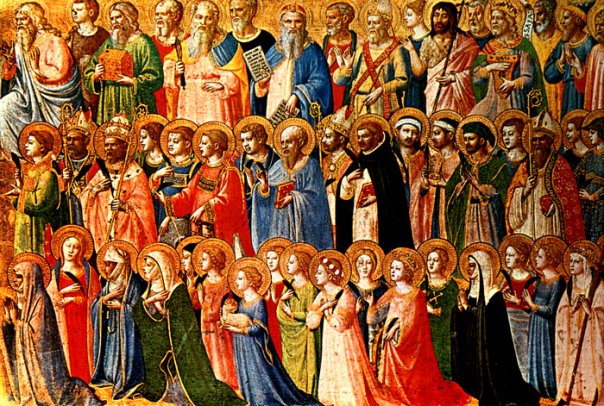
Photo: Fra Angelico, Wikimedia Commons / PD-US