
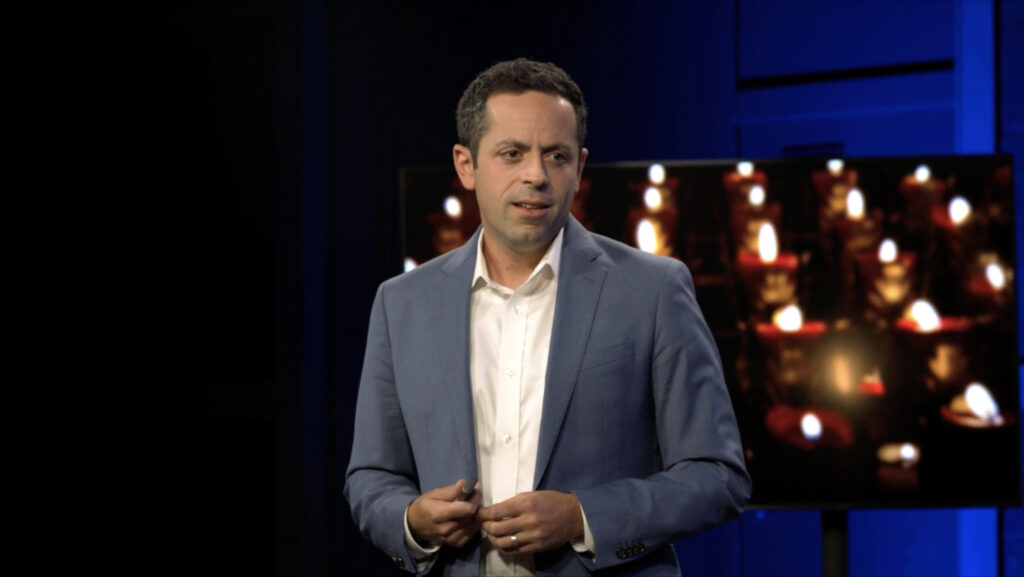
A thought-provoking new release from OSV Innovation Talks featuring Dan Cellucci, CEO of Catholic Leadership Institute (CLI), examines the implications of potentially one-third of Catholics not returning to the pews upon the reopening of in-person Masses nationwide. Asserting that leadership is often about asking the right questions, Cellucci challenges Church leaders to envision progress and possibility as opposed to fear and risk when facing the question of his aptly-titled talk, “What If They Don’t Come Back?”
In his work with CLI, Cellucci has studied the practices and beliefs of Mass-going Catholics for the last decade. He is well-versed in the statistics and trends of disengagement and disaffiliation particularly among millennials and Gen. Z, and so it is not with callous disregard that Cellucci boldly acknowledges that those who have been practicing their faith out of habit will not return now that the habit has been broken. Cellucci is alternatively convinced that the radical changes in the landscape of the Church resulting from the pandemic offer not only reasons for concern, but glimmers of hope.
“We can’t deny that we needed a dramatic paradigm shift in how we equip the domestic church to pass along the faith to the next generation,” proposes Cellucci. “What if we were able to move a tech-ignorant Church to become a Church that is at least semi-comfortable with technology? We did that! Parishes that couldn’t send an email now know how to live-stream Mass. Grandmothers are leading the rosary over Zoom. We did that in six months! What does that teach us about the tremendous opportunities that still lie in front of us?” Cellucci affirms.
Cellucci posits that going back to “normal” is not a direction God is calling us. “Normal was a 30-year sacramental freefall; normal was 70 percent of our people not practicing the faith at all; normal was five percent of us doing all the volunteering. We could barely afford normal before we wanted to go back to it.”
“There has never been a better time to move forward, to re-think, re-imagine, and re-engage how the Church shares the Gospel,” challenges Jason Shanks, President of OSV Institute. “People are desperate for real relationships, real presence, and a reason to hope. OSV Institute is committed to leading the charge.”
OSV Innovation Talks is a series of powerful talks on a variety of important topics aimed at igniting innovation and creativity in ministry and evangelization. In partnership with ODB Films, this professionally-produced series presents a full lineup of impactful talks from prominent Catholic leaders. Tagged as “inspiration for Catholic innovators,” the series is meant to be a catalyst for new thinking as it relates to ministry, evangelization, and engagement between Church and culture.
In 1915, Fr. John Francis Noll began the OSV Institute to extend the reach of Our Sunday Visitor in service and support of Catholic organizations. With over $80 million returned to Catholic organizations to date, the OSV Institute continues to serve the Church by supporting and encouraging innovative and effective Church-related programs and activities. Three areas of special interest for funding are Re-Captivating Millennials, Hispanic Experience, and Supporting Parents. In 2017, the Institute expanded its reach to provide support for new innovation and to serve as an incubator for new efforts supporting the Catholic Church.
###


3 thoughts on “OSV Talks Series Explores “What If They Don’t Come Back?” in Powerful New Release”
Pingback: “What If They Don’t Come Back,” You Won’t Believe These Nativity Sets, and More! – christian-99.com
Catholicism is about communion, with our Lord in the Eucharist, but also with our brothers. If we remove that personal communion, we may have a form of evangelization, but even that will be lost unless a personal community can be established for those so evangelized. The sign that attracted the pagans to the early Christian church was “See how they love one another!” We lose that sign without a Christian community.
In my experience, parish liturgies trivialize Catholic doctrine and the Sacraments, at best. The Bishops just got around to admitting that numerous hymns in wide use are theologically muddled and corrupted.
So, it might just be better that a substantial number of people are not further exposed to error.