

Desperate times call for desperate measures. The modern world has successfully graduated from high school and is now ready to attend University where its ideals will be challenged and its preconceptions destroyed. The Church has always been charged with the task of taking what is True, Good, and Beautiful in any culture and time and lifting it up to God. It is of course only through this offering that the modern world will be able to retain its sanity through its college years.
In order to make this offering, the Church of course must understand the culture and embrace that which can and should be offered. One can look at our modern culture, see so much that is harmful and desire to run away. In fact, this even happens to me. Almost daily. However, it is not this running away that converts the world. Instead, we can only convert that which is harmful in the culture by showing where that which is good fits into the Truth revealed to us.
Christianity took what was desirable (read: True) in Greek philosophy, Roman law, and Hebrew ritual and successfully turned Man’s eyes to God. Since that time, it’s been doing the same thing with every other culture it encounters. In this way, it adapted a Roman building type to northern building methods and mystical theology and came up with the Gothic. In this way, it revolutionized feudal Europe and developed chivalry. In this way, it revived Classical art combining it with Enlightenment thought and came up with the Renaissance. These were of course major cultural phenomena that needed the attention of Christians, but between these there were also smaller cultural adaptations and sanctifications that occurred through the work of missionaries especially.
It seems to me that we are once again at a point where a broad cultural reality needs adaptation and sanctification, and I’m not talking about the internet (I will leave that to people whose passion actually is in the tech fields.) Yes, there are still opportunities for missionary work and the sanctification of specific cultures, philosophies, and world views, but I am talking about something in our own culture: Contemporary Architecture.
You can leave now if you’re not interested in reading about architecture (I can’t imagine most people would), but you’d miss some pretty sweet pictures of some pretty sweet churches.
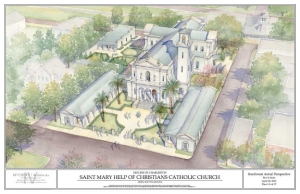
Also, before I go on, I have to make this disclaimer: I consider myself very much a modern architect with an eye on the lessons history teaches us and a particular fondness for Gothic architecture.
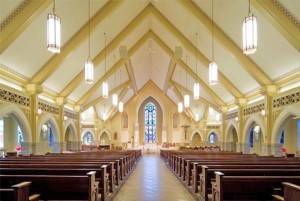
Within the last 10 years, there seems to have been a concerted effort on the part of certain parties to make traditional church architecture more desirable to the modern Faith Community. The fact that it has coincided with the efforts of the New Translation has not escaped me. This movement of both the community itself and some specific architects has resulted in a few very good churches that hearken back to traditional forms and materials. It has also spawned quite a few “churches that might have been”, churches that try to express something of traditional church design but fail in a few important and many less important ways.
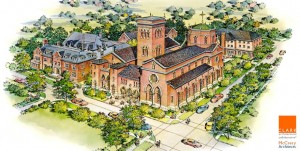
Now in looking at examples of these churches, we can see that there is a bit of a dichotomy. The best of the former category, the truly traditional churches, try to emulate certain styles to one extent or another, mostly ones that are quite old, well-used, and trustworthy. The churches in the latter category occasionally use hints of stone and brick, but in essence they are churches that use primarily new building technologies and methods. I have absolutely no complaints about communities that choose to build churches using stone and brick in traditional ways to create churches that recall the majesty of the great churches in history, but that is not the whole story. The problem as I see it (we must always find a problem, must we not?) is that in building such great churches in traditional styles, we overlook the potential in our own contemporary architectural trends.
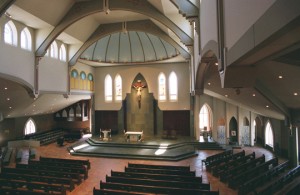
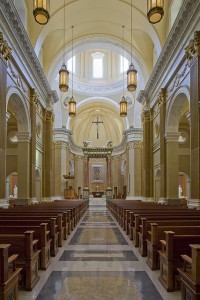
Some may say “If something’s worked for so long, why reject it?” and I say “Good question.” However, I’m not saying reject the older ways of designing and building churches (in fact, I love them) but if we are to touch the hearts of contemporary man, we must adapt and sanctify his projects as well as the projects of his fathers. The conversion of the culture can only happen if we wring it of its Truth Beauty and Goodness.
It seems, if we look at my second category of churches above, that some have tried to accomplish this and for that I commend them. But I would say they have tried and failed most likely through ignorance of either architecture, theology, liturgy or all of the above. The incongruity of trying to mesh traditional elements with modern elements is not the delightful incongruity of hipster fashion, it is the incongruity of reaching into the wrong drawer when trying to find socks and putting a shirt on your feet instead.
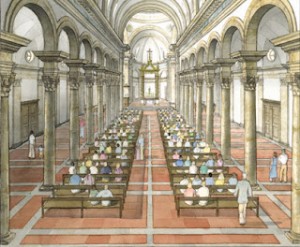
So, I guess what I be saying is this: If we want a return to a God-centered liturgy and church design, it’s not enough to use so called “traditional” church design, in the strict sense. We must align our current design capabilities with that tradition and thus move modern man with his own inventions and abilities toward heaven and his creator.






7 thoughts on “A Church in the Modern World”
Honestly, we have some awesome building technology that’s been developed as of late–and design technology! You can do SO MUCH with a 3-D modelling program. What we need to maintain in mind at all times, however, is that churches are designed to fulfill several functions (after being able to stand without collapsing, of course… though you may want to tell that to the architects of Saint-Pierre in Beauvais):
1. Act as a prayerful space for the Mass. This requires integration with the liturgy and, therefore, an intimate familiarity with the aforementioned liturgy.
2. Denote itself as a church through its exterior envelope, whether it be via spires or exterior ornamentation or some other thing. It should still be able to somewhat blend in with its neighbourhood, though, to a certain degree.
3. Keep historical precedents in mind. Just because we want to move forward with design doesn’t mean we completely throw out columns, domes, spires, or triumphal arches. Instead, they need to be adapted to fit the times.
One of the chronic ideas I’ve noticed is to have an utter disregard for many pre-Modernist-movement historical precedents (with the notable exception of Palladio). Because architecture is rarely Architecture these days, symbolism and underlying geometries are frequently looked upon with the mindset that they are no longer necessary.
But that’s just my two cents.
~Ink
Hello Nathaniel,
I find it interesting that as the Protestants move towards the white-walled, technology-driven buildings, many Catholic churches are starting to bring back the beauty of old architecture and traditions, such as re-installing altar rails and bringing back the good ol’ fashioned wooden (non-padded) pews. Personally, I find that in a church that has beautiful stained-glass windows and varied architectural details (arches, domes, etc.) my mind is more lifted to Christ than in the more “modern” churches. But, I do agree with you in that there have been some elements of the new movement that have been incorporated with the old in a beautiful fashion. The church at Ave Maria University is a good example, in my opinion, of this. Though the shape of the building- on the outside- isn’t horribly attractive, the front entrance is gorgeous, and some of the details on the inside are truly beautiful. It’s not easy, though, trying to incorporate such new, different ideas with the classic ones.
Thanks again for this post! I enjoyed the pictures- they illustrated your point very effectively.
God bless!
Yeah, and I think my point is that we have to use altar rails again and everything, but in design, using forms that come from modern materials and the like. Traditional materials are all well and good, but we can’t let the Protestants be the only ones using technology (and I don’t mean Projection Screens). We have to bring it into line with our liturgical traditions.
We could totally use Projection Screens in an overflowing Mass. Like anything at the March for Life.
~Ink
Well, of course, but that’s not what I meant by using technology for architecture, of course.
Well I really don’t think the so called “modern” or contemporary style will do much to speak to modern man. Typically, it is not modern man that is moved by these churches, but rather weird elitist people will deplorable taste. The architects, even if they’re not heretics, are generally not artists. So they’re churches aren’t very artistic and aren’t very beautiful.
And newer church buildings settle for less because anything real good (like the churches of old) cost a LOT of money (they cost just as much back then too). We live in a secular society that isn’t too keen on sacrifice (as in, give your life to build a pretty church) so expensive churches usually aren’t being built.
In any case, I do think it would be grand if some new style that was genuinely beautiful were to be developed. I haven’t seen it yet.
…how does one take Enlightenment thought from the 18th century and come up with the Renaissance? Is there a typo someplace?