

My friend Marc Barnes recently posited that beauty can save the world–and he’s right.

Yet we must be careful that we don’t confuse our sense of beauty with beauty itself. Beauty can be sensed, and is a sixth sense that uses the other five as its handmaidens. However, like good taste in wine, beauty can be as deceiving as a vin bas de gamme. We are conflicted animals. We throw away a month’s salary to spend a week in a box, with a hole cut out, so we can get a glimpse of what God did with one word of His breath. Our aesthetic sense rightly tuned for a moment, we are caught up in the surf, sun, and seagulls cawing for our attention to “see” that the Lord is good and His mercy endures; endures with each lap of the interminable wave. Yet we come unglued, and next thing you know we are crawling back from the hole–the vision of grandeur and goodness–and turn on a different box and numb our minds with endless meaninglessness. As I mentioned, we are conflicted animals.
In the “fullness of time” when God revealed himself to us, when Truth put on flesh and looked us in the eyes, we overlooked. The scene of greatest beauty, the scene of redemption, is the hour our aesthetic instinct tragically failed us. Like the crowds that followed Christ, we are waiting for a King triumphant and for beauty that is clean and congruent. However, the Cross is the most incongruent moment in history while yet at the same time the most beautiful and true.
Tragically, you and I cannot claim divine ignorance. His friends at Golgotha were supposed to miss him. However, we miss Christ and the paradoxical beauty of the Cross for entirely different reasons. Our Cartesian impulse to conquer nature and our obsession with techne leads us down an inevitable path tracking towards some illusory escape hatch of reality. Constantly and nervously looking for an exit sign, our society has built itself on a foundation of fissure. We eat what we do not know. We kill who we cannot see.
Beauty is in the eye of the beholder. For my purpose, I do not mean this to say that it is a subjective appetite. Instead, I emphasize “beholder” because beauty must be “held”. To hold beauty is to be filled up by it. Beauty baptizes you, you do not dip your toe in it. As with the ocean, you will never truly experience beauty until you let it take over. The problem with the subjectivist is that they want to ride on their own shoulders. This is impossible, and so too the scandal of the Cross is that the distance between Christ’s feet and the ground is a distance we cannot work out. Only if we allow the beauty of the moment–the Person of the moment–to baptize us into himself are we extended an invitation to join the epic beauty of crucifixion. It is when we enter into it–death, that we begin to realize what vivifies our aesthetic sense; what resurrects our instinct to stay in the presence of God instead of fleeing.
A society that insists on dipping its toe in the ocean will never understand truth. Truth is beyond our safe experience of it. It is what calls us deep into the Ganges of our soul, it is what compels the truly great artist to paint or play, it is what makes a man die for his family, country, and honor. Moreover, I have four times witnessed one of the most life-changing and beautiful events one can experience on this side of the eternal threshold. Four times I have been an intimate party to this paradox of beauty, and four times I have been changed as I allow the moment to baptize my broken sense of truth.
If you have ever seen a child born, you know what I am talking about. The moment is completely out of your control. The raw emotion of a human making its introduction on the stage of the homo erectus is more than the light of heart can bare. Yet in this gruesome, grueling, and bloody moment, the paradox of beauty penetrates you in a way that could cause even the doubter to imagine he were an illuminati. For in that moment, when truth fills us up and all our expectations and our need for power fall helplessly at the altar of the “I am”, we “see” love. God is love, but he is not tamed by our sympathies and false affections. So too, the moment of a child being born draws us into the transcendent nature of Truth and how the child’s inevitable trajectory toward suffering and ultimately death is our invitation to enter more deeply into the mystery and victory of the Cross.
We obviously cannot invite everyone into the delivery room, so how or where does one go to ponder the mystery of truth: the paradox of beauty?
The Sacrifice of The Mass
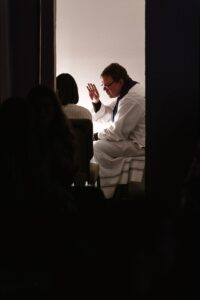
The liturgy presents in vivid detail the paradox of beauty. If the liturgy truly is God’s gift of beauty to us, then Tolkein’s greatest achievement was to use the liturgy as an archetype for communicating his own story. If the liturgy is God’s gift of beauty to us, then Michelangelo’s Pietas is his rendering of his soul in meditation upon our Lord through the eyes of the Virgin. Father Z coined the phrase “Save the Liturgy, Save the World” and I think he is not far off of Marc’s observation. Don’t think the newest chorus will do it. When we complain about the 70’s songs sung in Mass, remember that it was someone in the 70’s who thought that by introducing them they would “contemporize” the Mass. The impulse to make the Mass relevant is as absurd as making the Crucifixion “relevant” or child-birth “relevant”. It is like the child who is afraid of the ocean, and instead, digs a small hole just off the shore and caries water to it in a bucket. Not only does she just dip her toe in the ocean, but she gains the illusion of controlling the uncontrollable.
The liturgy is our greatest chance to introduce humanity to real beauty. It is the protoevangelium which preceded the Gospels. It is Our Story. In the Mass, we are invited to be baptized into the beauty of truth. It is no coincidence that our hand starts in a font and ends in a font. However, if one merely dips their finger and in-between dips doesn’t allow the transcendent beauty of the divine liturgy to transform your aesthetic compass, you will think it a tame show. You will propose all kinds of improvements and innovations to port the ocean into your bathtub; to ride on your own shoulders.
Instead, like in the delivery room or at Golgotha, we should allow the transcendent truth of the moment to vivify–to bring back to life–our dulled sense of the beautiful. Especially in the Eucharistic liturgy, we are invited to participate in the scandal of beauty: God becoming flesh to come to us in the form of bread and wine that we might consume Him. So backwards a thought to our sensibilities–consuming God, yet so forward in His desire to be with us for eternity. If that is not beautiful, I do not know what is.
When the people of God resurrect their sense of beauty, we will be able to lead others similarly to that paradoxical place where Truth kisses death and wins. Until then, we will only be able to lead them to our small pool, to dip their toe in a little more water than can provide a toe for dipping.
We can convert the entire world through beauty.
But we have to be converted first.
Like what I had to say? Hate it? Check me out at my blog where I discuss why I’m Catholic and other things about that @www.almostnotcatholic.com




7 thoughts on “Truth: The Paradox of Beauty”
VERY true! You just have to look around the Internet to see how true it is: what people are really searching for is the beauty they’re drawn to without knowing why. All beauty is a faint glimpse of God!
I enjoyed this one. Thanks, Brent
Beautiful. Thank you.
Great! Let’s celebrate beauty in all its forms..nature, children, the arts, the beauty of human love in its most unselfish forms.
How can the beauty of the litugy be rediscovered? Where does music fit in?
“Don’t think the newest chorus will do it. When we complain about the 70′s songs sung in Mass, remember that it was someone in the 70′s who thought that by introducing them they would “contemporize” the Mass.”
Thank you!
Very nice.
One thing – Homo erectus exited the stage a long, long time ago. Didn’t you mean H. Sapiens?
Bruce,
In the general philosophical sense, we are still the animals “set up right”. I meant it in this sense not the scientific sense.