He made them the vicars of his love. – St. Ambrose of Milan
It is a special grace to be able to accept the invitation to become a Catholic priest, and it takes a lot of courage and strength for a man to continue on the journey through six to eight years of seminary and then to give his forever “yes” on Ordination day to serve the Lord and the Church. It is a unique vocational calling for a man to have the perseverance to live his priestly life of self-surrender where he makes the sacrifice to give up the power, pleasure, and prestige of the world for the sake of the Kingdom. Archbishop Timothy Cardinal Dolan in Priests for the Third Millennium states:
The Priesthood is a call, not a career; a redefinition of self, not just a new ministry; a way of life, not a job; a state of being, not just a function; a permanent, lifelong commitment, not a temporary style of service; an identity, not just a role. [1]
The Catholic priesthood is not for the faint of heart. It is a serious commitment where a man lays down his life entirely and completely in self-emptying love so that he can live more fully in Christ. St. Gregory of Nazianzus when discussing the ministerial priesthood exclaims:
We must begin by purifying ourselves before purifying others; we must be instructed to be able to instruct, become light to illuminate, draw close to God to bring him close to others, be sanctified to sanctify, lead by the hand and counsel prudently. I know whose ministers we are, where we find ourselves and to where we strive. I know God’s greatness and man’s weakness, but also his potential. [Who then is the priest? He is] the defender of truth, who stands with angels, gives glory with archangels, causes sacrifices to rise to the altar on high, shares Christ’s priesthood, refashions creation, restores it in God’s image, recreates it for the world on high and, even greater, is divinized and divinizes. [2]
People either consider priests to be fools for giving up the ways of the world or hold them up on a pedestal as if they are already canonized Saints, but most people in general fail to recognize the humanity of a priest. A priest is made up of flesh and blood just like you and me, and also shares in suffering from the consequences of Original Sin along with us. Priests are not incapable of erring, they can make poor errors in judgment, and fall to temptation just like the rest of us. None of us are sinless, and so priests are also sinners as the result of their humanity. The truth is that none of us are faultless because of our fallen human nature. St. Josemaria Escriva in his work In Love with the Church states:
A priest is no more a man or a Christian than any ordinary lay person. That is why it is so important for a priest to be deeply humble. He must understand that these words of Saint Paul also apply to him in a special way: What have you that you did not receive? What he has received… is God! He has received the power to celebrate the Holy Eucharist, the Holy Mass (the principal purpose of priestly ordination), to forgive sins, to administer the other sacraments and to preach with authority the Word of God, governing the rest of the faithful in those matters which refer to the Kingdom of Heaven. [3]
When a man receives the Sacrament of Holy Orders his ability to sin does not disappear, however, he does receive an indelible mark or spiritual character gifted to him by the Holy Spirit to enable him to be able to minister to the People of God as an instrument of Christ for the Church. [4] A priest acts in persona Christi not by his own authority or name, but by the power given to him by Christ Himself to change the bread and the wine into Christ’s Body and Blood during the Holy Sacrifice of the Mass and to forgive sins. A priest, if he was consciously aware of his own unworthiness and shortcomings, which he shares with the lay members of the faithful, would find much difficulty in uttering the words “This is my Body…This is my Blood,” at the consecration, but he is able to celebrate the Mass because of the special grace that God has given to him.
A Catholic priest is not a “Mass machine,” where he works like a robot to deliver us the Sacraments endlessly and tirelessly day in and day out. Priests are men. Once a man receives orders to the sacerdotal priesthood he does not surrender his manhood and no longer experience any personal strengths or weaknesses. There are priests who had the desire to become a priest at five years old, others felt called immediately after high school, and yet some others did not feel the call until later in life. Their entire life experience up until Ordination does not disappear at the laying on of hands. It is a part of them and shapes who they are today as members of the clergy in the same way that our journey has led us to who we have become right here and right now in our present day lives.
A priest is not perfect like God; the fact of the matter is that none of us are perfect. As members of the human family we are all on the journey towards holiness or perfection as we grow closer and closer to God. We should not idolize the priest even if we love and highly respect him because we are then revolving our spiritual lives around a man and not God. The priest is simply an instrument of the one perfect Priest, Jesus Christ.
We know from the Baltimore Catechism that God made us to “know Him, to love Him, and to serve Him in this world, and to be happy with Him forever in the next.” The difference in the priest’s vocation as compared to the vocation to marriage, for example, is that the priest is a public servant for all eyes to see…and to critique. We recall Jesus’ words in the New Testament, John 8:7, during the story of the adulteress woman, “He that is without sin among you, let him first cast a stone at her.”
It is easy to criticize a priest when it comes to matters at the parish level for this or for that when we ourselves are not observed like a specimen under the microscope. We need to remind ourselves that we do not know the whole story, and may not need to know why a priest makes certain decisions for the parish family. Especially, when it comes to our pastors, who need to know a lot more than we need to know and make certain decisions for the good of the members of the parish as a whole because they have been given to us to be the shepherd of our souls.
We cannot shepherd our own souls, and so it is important that we accept and utilize our role as the laity and do not attempt to take on that which belongs to the role of the ordained minister and the Presbyterate. If it is not a matter of grave sin that needs to be addressed then we can pray for the priest and offer it up to God.
Despite the sacrifice, contempt, and ungratefulness that surrounds the vocation to the priesthood, there are still men choosing to give all to God and become a Catholic priest. It is of utmost importance that we pray for our priests because they very much need our prayers. Pope Francis in his Letter to Priests on the 160th Anniversary of the Death of the Holy Cure of Ars, St. John Vianney, writes “Countless priests make of their lives a work of mercy in areas or situations that are often hostile, isolated or ignored, even at the risk of their lives.” [5]
We should offer prayers and penance not only for the priests that we love, but also for the priests that we may consider a thorn in our side. The priesthood is a vocation of sacrifice where day in and day out they serve the Church; the People of God. They have chosen a lifetime of celibacy over marriage, and spend their days doing so much more than celebrate Mass for us. Let us support this special vocation by praying for more good, holy, and faithful vocations to the priesthood.
_ _ _ _ _ _ _ _
- See Timothy Cardinal Dolan, Priests for the Third Millennium (Huntington, IN: Our Sunday Visitor, 2009).
- St. Gregory of Nazianzus, Oratio 2, 71, 74, 73:PG 35, 480-481.
- Josemaria Escriva, In Love with the Church (Strongsville, Ohio: Scepter, 2008), 40.
- Catechism of the Catholic Church, §1581
- Pope Francis, Letter of His Holiness Pope Francis to Priests on the 160th Anniversary of the Death of the Holy Curé of Ars, St. John Vianney (Rome: Libreria Editrice Vaticana, 2019), https://www.vatican.va/content/francesco/en/letters/2019/documents/papa-francesco_20190804_lettera-presbiteri.html.
____________
Originally published at Missio Dei
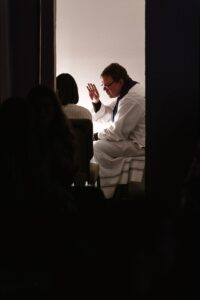
Photo: Josh Applegate, Unsplash / PD-US