
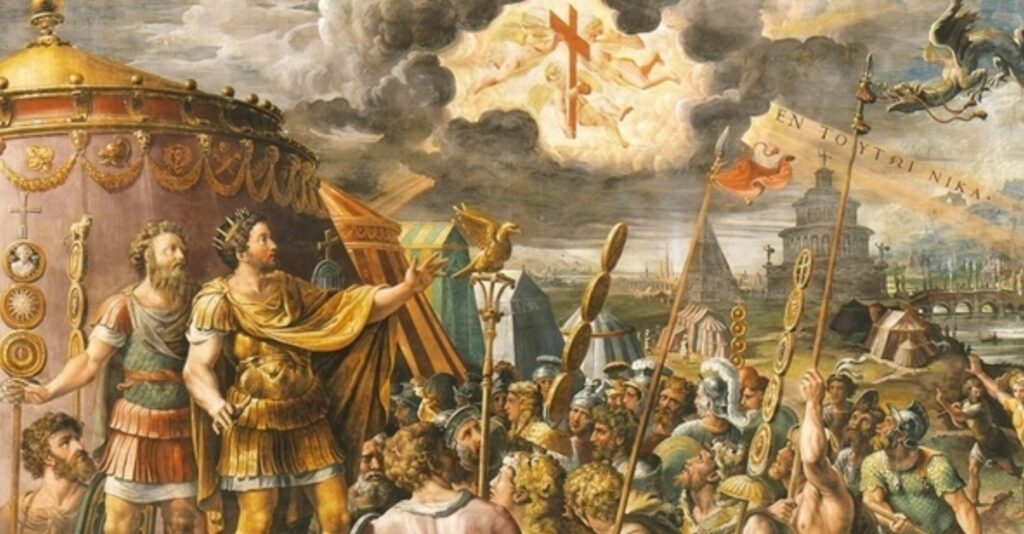
In the Bible, when the Israelites lose a battle, they ask: What have we done to offend God? Who slept with his sister? Who stole pagan gold? Then they punish the offender and hope for God’s favor in the next battle.
With the conversion of Constantine and the legalization of Christianity, this logic came to apply to the Church. It’s not until The Song of Roland that a loss in battle is seen as morally neutral. Roland dies, and no one inquires into his misdeeds but hails him as a martyr.
The idea of success in battle as a sign of God’s approval also took the form in Christendom of trial by ordeal and trial by combat. Dante claims that if two Christians or Christian nations both invoke God as their witness, the outcome of the contest must be evidence of God’s will (Monarchy II, ix, 5). Richard II tells Henry IV, “As thy cause is right, / So be thy fortune in this royal fight” (RII I.3.350-51). Victory is taken as evidence of divine blessing.
And yet some Christians are nostalgic for the good ol’ days of early Christian persecution, when it was a scrappy, underground movement. Certainly, with the legalization of Christianity, people converted without sincerity and for political gain. It is a heavy price to pay.
Ever since the declaration Dignitatis Humanae in 1965, some Catholics have frowned on any cooperation between the church and the state. And yet nothing in the document prevents the church from supporting pro-life, pro-family policies and from fighting against fornication, birth control, pornography, and IVF with legal means in the public sphere.
Liberals are always clamoring for change. It would be a change indeed to see Cardinal Dolan ride a horse down Capitol Hill to anoint Donald Trump king, but I doubt that is the change they are looking for.
Saint Constantine was not perfect, and neither is Donald Trump. But voting in America will always be a question of the lesser of two evils. Without hoping in Trump as we do in Jesus, we can still cringe at “Swifties for Harris” and encourage others to vote for the more, though not perfectly, pro-life candidate. A prayer-and-fasting-Benedict-option approach does not rule out one’s civic duty of voting.
The legalization of marijuana has shown that the law is a teacher. Illegal things become less common. Legal things become more common. We need laws that inform and direct our consciences toward human flourishing in accordance with the natural law.
I would not call voting for Trump “a deal with the devil” any more than the baptism of Clovis or the coronation of Charlemagne. Christians who utterly eschew political power and instead condemn the crusades are content to give the Holy Land to heretics and to let ISIS destroy the grave of Jonah.
The greatest event in the history of church-state relations was brought about through prayer. No one could have foreseen the conversion of Emperor Constantine at the Battle of Milvian Bridge. Nothing did more for the church in a temporal sense.
Donald Trump is not a Catholic. But all he needs to do is tear up his pre-nup with Melania and enter RCIA. More wonderful things have happened.






1 thought on “Constantine: Saint or Sinner?”
In some ways, this is so much more enjoyable than all the polemical political rhetoric that has been published in the last two months. This is true:” But voting in America will always be a question of the lesser of two evils” – except in the case of a catholic with a well-formed conscience who knows what some individuals, some candidates, and presently all democrat candidates have done, are doing, and have promised to do to further intrinsic evils. Evils like racism, abortion, torture, and transgenderism. No matter what is in the balance or taken account in a “lesser evil” calculus, one can never formally cooperate in intrinsic evil. One -one who has a well-formed conscience – can never vote for such candidates- and since the Democrat Party has now run off the last so-called “prolife democrat,”- and considering all the other death-dealing intrinsic evils they promote – one cannot vote for any democrat without gravely sinning. Guy, Texas