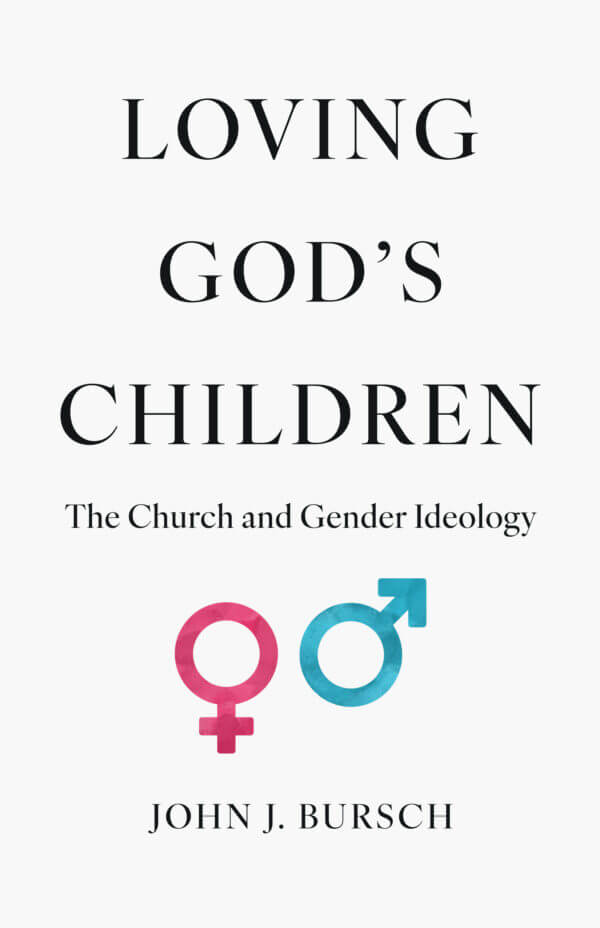
We are pleased to present the excerpt from “Loving God’s Children: The Church & Gender Ideology” by John J. Bursch, published by Sophia Institute Press.
The problems with separating sex and gender
As mentioned at the outset of this book, the Congregation for Catholic Education in 2019 published Male and Female He Created Them: Towards a Path of Dialogue on the Question of Gender Theory in Education. The document begins by acknowledging that in modern culture, “sex and gender are no longer synonyms or interchangeable concepts, since they are used to describe two different realities. Sex is seen as defining which of the two biological categories (deriving from the original feminine-masculine [pair]) one belonged to. Gender, on the other hand, would be the way in which the differences between the sexes are lived in culture.”
“The problem,” the document continues, “does not lie in the distinction between the two terms, which can be interpreted correctly, but in the separation of sex from gender.” In other words, they become words that describe two distinct categories that can be mixed and matched at will. The result “is that the individual should be able to choose his or her own status, and that society should limit itself to guaranteeing this right, and even providing material support, since the minorities involved would otherwise suffer negative social discrimination.”
The Congregation acknowledges that the Church and gender-ideology proponents “share a laudable desire to combat all expressions of unjust discrimination.” But as we’ve discussed at length, to truly act in love always requires abiding in truth; loving always means living in reality (created and extolled as “good” by God) and helping others to do so. And the truth is that the “underlying presuppositions of [gender-ideology] theories can be traced back to a dualistic anthropology, separating body (reduced to the status of inert matter) from human will, which itself becomes an absolute that can manipulate the body as it pleases.” And this “combination of physicalism and voluntarism gives rise to relativism, in which everything that exists is of equal value and at the same time undifferentiated, without any real order or purpose.”
We already know where such relativism leads: “These ideas are the expression of a widespread way of thinking and acting in today’s culture that confuses ‘genuine freedom with the idea that each individual can act arbitrarily as if there were no truths, values, and principles to provide guidance, and everything were possible and permissible.’ ” And in some cases, it can also lead to stereotypical rigidity: a girl who climbs trees and likes sports must be a boy, and a boy who likes to “play house” must be a girl.
In contrast, explains the Church, “the Holy Scripture reveals the wisdom of the Creator’s design,” which assigns “masculinity and femininity” to each of us as “the clear sign” in which we give ourselves to others. “Thus, human nature must be understood on the basis of the unity of body and soul.”
“The denial of this duality not only erases the vision of human beings as the fruit of an act of creation but risks the idea of the human person as a sort of abstraction who ‘chooses for himself what his nature is to be.’ ” Hence, the Catechism of the Catholic Church declares that “sexuality affects all aspects of the human person in the unity of his body and soul” (CCC 2332).
This understanding of the body informs our understanding of the family. “The family is the natural place for the relationship of reciprocity and communion between man and woman to find its fullest realization.” That makes sense: the family is the context in which a man and woman can most freely give every part of themselves to the other: “For it is in the family that man and woman, united by a free and fully conscious pact of conjugal love, can love out ‘a totality in which all the elements of the person enter.’ ”
Indeed, that is the lesson the Church asks us to teach our children. Every child has the fundamental right to “grow up in a family with a father and a mother capable of creating a suitable environment for the child’s development and emotional maturity.” And it “is precisely within the nucleus of the family unit that children can learn how to recognize the value and the beauty of the differences between the two sexes, along with their equal dignity, and their reciprocity at a biological, functional, psychological, and social level.” While we should recognize that not every individual forms a family, we also know that by design, each of us reflects the reality that we came from a family, and we each have a body designed to create a family, whether we do so or not.
Rejecting these truths about sex—including the associated truths about marriage—has promoted a dysfunctional notion of freedom and has caused great harm to families and children.