

We are grateful to share our guest writer Sr. Mary Ann Fatula’s excerpts from “The Wonders of the Mass and the Eucharist: Insights of the Saints” by Sophia Institute Press.
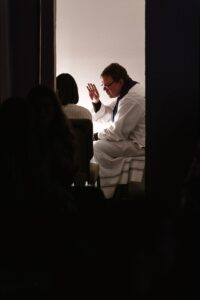
Above all other blessings, the most precious gifts of the Trinity to us are the Mass and the Eucharist. Absolutely nothing in this world is more consoling, more life-giving and life-changing than the Mass and its most sacred Fruit, the Eucharist. Astounding mysteries of love take place at Mass! Through His ordained bishops and priests, the Lord Himself makes present to us His tender Last Supper, His saving death, and glorious Resurrection for us, and feeds us with His own precious Body and Blood in the Eucharist.
We learn to treasure and live these amazing Wonders especially from the saints, whose writings were anointed by the Holy Spirit and whose own lives were transformed by their love for the Mass and the Eucharist. St. John Chrysostom begs us to pray daily for deeper faith so that we, too, may truly “see” what really takes place at Mass. We are not simply remembering the Lord’s Last Supper and His sacred death and Resurrection for us. No, we are truly there! At every Mass, the Lord Himself is making present for us His infinitely tender Last Supper, His sacred death on the cross, and His glorious Resurrection for us. As the Holy Spirit inwardly teaches us about these astounding Miracles of love, we will want to attend Mass as often as we can and come early to prepare for the sacred Wonders the Lord Himself will accomplish for us at Mass.
St. John Chrysostom also assures us that, just as at the Last Supper, the Lord’s desire and purpose at Mass is to feed us with Himself. Jesus knows our longing to be as physically close as possible to those we love. A phone call and face time are blessings, but nothing can compare with holding our loved ones, physically, in our arms. Does the Lord love us any less than we love one another? Impossible, St. John Chrysostom cries out!
Jesus loves us so passionately and tenderly that nothing less than giving Himself physically to us satisfies His desire to be close to us. We need not envy the apostles and disciples who enjoyed so intimately the Lord’s physical presence with them. “You see Him, you touch Him, you eat Him!” In Holy Communion, we receive not a mere symbol or remembrance of Him, but all of the Lord Himself: His precious Body crucified on the cross for us, His sacred Blood shed on the cross for us. Sts. John Chrysostom, Thomas Aquinas, and Catherine of Siena urge us to trust in the Blood of Jesus in the Eucharist to guard and protect us from all attacks, especially of the demons, who flee in terror before the Precious Blood of Jesus.
St. Alphonsus Liguori assures us that the Lord unceasingly gives us the comfort and power of His physical closeness to us because He “cannot bear to be separated from us.” “Those who eat My Flesh and drink My Blood live in me, and I in them” (John 6:56). St. Thomas Aquinas tells us that the Eucharist itself, the great Sacrament of Love, brings us forgiveness for our venial sins. If we have committed grave sin, let us go to Confession, and then receive the Lord with confidence. As St. Thérèse of Lisieux urges her dear cousin and all of us in our own struggles: “Go without any fear to receive your only true Friend. Receive Communion very often.” This is the “Remedy” that brings us healing.
After we have received Jesus, let us stay a while with Him (Matt. 26:38), giving Him our cares, entrusting to Him our loved ones and all that troubles our peace of heart. St. Alphonsus Liguori promises us that if we try to spend even a little time with the Eucharistic Lord whenever we can, we will find the answer to all our problems. Just as the Lord worked miracles when He walked this earth, He longs to work miracles of love and healing for us and those dear to us. St. Teresa of Avila reminds us that when we receive Jesus in the Eucharist, we welcome Him into our “home,” where He fills us with the peace and contentment which only He can give (John 14:27).
With St. John Vianney, St. Teresa implores us never to be so busy with attending to “more important matters” that we have no time for Jesus. Even when she herself felt no devotion, she would simply rest with Jesus in the Eucharist, for she knew that it “good for us” to be with Him (Matt. 17:4). With St. Thomas Aquinas and all the saints, Teresa also realized that faith is not a matter of good feelings, which come and go; faith is rather the desire to be converted and to believe ever more deeply: “Lord I believe; help my unbelief” (Mark 9:24).
After Holy Communion and during Eucharistic adoration, let us then rest on the Lord’s heart as the beloved disciple did at the Last Supper (John 13:23), simply letting Him love us. St. Thomas Aquinas tells us that nothing on earth is as sweet as the physical presence of the Lord with and within us in the Eucharist; “Taste and see that the Lord is sweet” (Ps. 34:8). But we can’t taste His sweetness if we don’t take time just to “be” with Him. We don’t need many words. St. Teresa of Avila assures us that Jesus has no desire for us “to tire our brains by a great deal of talking.” The Holy Spirit may place in our hearts simply the precious name of Jesus, or a short prayer or phrase which we gently repeat: “My Lord and My God;” “Jesus, bathe me in Your Blood.” We may not need any words at all. A dear man humbly told St. John Vianney about his daily visits with the Lord in the Blessed Sacrament: “I look at Him, and He looks at me.” “How beautiful,” Vianney comments. “This is the best prayer.”
As he contemplates the magnificent beauty and blessings that are ours in the created universe, St. John Henry Newman exclaims that infinitely sweeter is the Lord Himself. Let us never say that He Himself is “not enough” for us. As Sts. John Vianney and Thérèse of Lisieux assure us, Jesus is Heaven for us, our “Paradise” here on earth. Finally, Sts. Thomas Aquinas and John Paul II tenderly stress that at Mass and in the Eucharist, the great Sacrament of Love, the Lord increasingly unites us in own His self-giving love not only to Himself but also to one another, to those dear to us, and to those most in need.
From all these beautiful saints, we learn as from dear friends how fulfilling our lives become when we, too, draw our own healing and freedom, our peace and joy from the Lord’s intimate presence among us at Mass and within us in the precious sacrament of the Eucharist. Then, like the disciples on the road to Emmaus (Luke 24:13-35), may we be strengthened and inspired by the Holy Spirit to joyfully share the Eucharistic Lord’s love with others!
Author Bio – Sr. Mary Ann Fatula, O.P.
Sr. Mary Ann Fatula, O.P., holds a doctorate in systematic theology from The Catholic University of America and taught theology for more than thirty years at Ohio Dominican University in Columbus.




2 thoughts on “The Life-Changing Wonders of the Mass and the Eucharist”
Pingback: Encountering Christ in the Homeless and Powerful Tips for Evangelizing at a Stoplight, Doomed Chicago Church Saved by Landmark Status, and More Great Links!| National Catholic Register - My Catholic Country
Pingback: Encountering Christ in the Homeless and Powerful Tips for Evangelizing at a Stoplight, Doomed Chicago Church Saved by Landmark Status, and More Great Links!| National Catholic Register - News Trends