

We are pleased to share a synopsis about our guest writer Fr. Ralph Weimann’s book “Sacramentals: Their Meaning and Spiritual Use” by Sophia Institute Press.
Sacramentals are sacred signs and, therefore, indispensable means of grace. Through them, liberation from evil, healing of sicknesses, including psychological disorders, can occur, conversions may happen, they can help to overcome multiple difficulties in life, providing manifold help on the way to God. This is what this book is about Sacramentals. Their Meaning and Spiritual Use.
Such a book has been lacking until now. That is why the Prefect emeritus of the Congregation for Divine Worship and the Discipline of the Sacraments, Robert Card. Sarah, wrote in his foreword: “Fr. Weimann has succeeded in closing this gap with his vital publication. His book offers not only an excellent theological justification from a sacramental-theological perspective, but also practical and pastoral guidance that provides basic orientation for any priest, deacon, or lay person.”
That said, the general structure of the book is already described. In the first part, the theological foundations of the sacramentals are presented. It is neither about magic, nor about superstition, but about the truth of faith, which is Jesus Christ. He, the Son of the living God, is the source, providing efficacy and grace to the sacramentals. How this is achieved, what is essential, and what needs to be taken into account so that they can unfold their effects, is presented in the first part of the book. It is explained, that sacramentals function differently from the sacraments; their spiritual effects depend upon the living faith of the people, for only in this way can they ordinarily develop their efficacy. Already here it becomes clear how fundamental it is to live a truly Christian life.
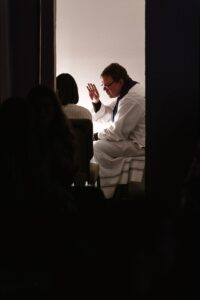
This is followed by some basic explanations and important distinctions. Thus, four categories of sacramentals can be distinguished: a first group consists of blessings, which are used most often. Usually, it is the cleric who blesses, but parents may bless their children. The second group comprises non-sacramental blessings, called consecrations. They produce a lasting effect. Especially among the faithful, they are currently very popular, such as the consecration to the Immaculate Heart of Mary, or the consecration to the Sacred Heart of Jesus. The third group consists of exorcisms. It is the power of God that makes it possible to prevent the influence of the evil one (Satan), thus providing liberation. A distinction is made between the major and minor exorcisms, providing significant criteria to this very delicate topic. Only when the basic rules are known, respected and applied can an adequate response to the four different forms of extraordinary demonic activity be provided. All this is explained in the book based on solid reasoning. The fourth group comprises sacred objects, which are becoming increasingly popular among the faithful. For example, the veneration of relics, the use of sacred oils.
In the second part of the book practical hints are given, which can serve as important stimuli for the life of faith. Thus, the invocation of the name of Jesus, if made with living faith, can lead to salvation, purification, liberation, and healing. The present explanations are constantly based on Sacred Scripture and the Tradition of the Church, which allow one to offer objective guidelines that are even more important because sacramentals have been neglected in recent decades. Whoever makes them his own for his life can take away valuable inspiration and will so be able to practice the faith more consciously, because it is that treasure, for which it is worth selling everything (cf. Mt 13:44).
Even though many Christians make the sign of the cross, only a few are aware of the great spiritual power inherent in this holy sign. Given that it is used in all sacramentals, a detailed explanation follows, which should lead to making the sign of the cross more consciously in order to obtain abundant effects of grace. This understanding is not only important for priests but for all the faithful. Since only when it becomes comprehensible what blessings are all about, and why it is important that persons, objects and places—especially our homes—are blessed. The same applies with regard to the spiritual effect of blessed St. Benedict’s medals or miraculous medals.
In the book Sacramentals. Their Meaning and Spiritual Use, in addition to precise explanations based on Scripture and Tradition, there are many practical directions that can help us to consciously live our faith and to benefit more from the spiritual effects of the sacramentals. A glossary is provided at the end of the book, where all technical terms are explained once again. In this way, even simple people are able to read this book with great profit. Even more, priests, as well as laypeople, are encouraged to make generous use of the sacramentals. It is the special merit of Sophia Press to have made this book now accessible.
Author Bio – Fr. Ralph Weismann
Fr. Ralph Weimann studied in the United States, Italy, and Germany and obtained a diploma in humanities, a bachelor’s degree in philosophy, and a licentiate degree in theology. He earned a doctorate in theology in 2010 on the thesis “Dogma and Progress in the Theology of Joseph Ratzinger.” He earned a second doctorate in 2013 on the thesis “Bioethics in a Secularized Society.” He has worked as a military chaplain since 2015. Fr. Weimann lectures at various colleges and universities in Rome, particularly the Pontifical University of St. Thomas Aquinas (Angelicum) and the International Online University Domuni.



3 thoughts on “Sacramentals: Their Meaning and Spiritual Use”
Pingback: St. Ignatius’ Advice for Being More Joyful, Goodness in the Face of Evil Must Suffer, Why Didn’t Jesus Go to the Abode of the Damned, and More Great Links!| National Catholic Register - My Catholic Country
Pingback: St. Ignatius’ Advice for Being More Joyful, Goodness in the Face of Evil Must Suffer, Why Didn’t Jesus Go to the Abode of the Damned, and More Great Links! - JP2 Catholic Radio
Pingback: St. Ignatius’ Advice for Being More Joyful, Goodness in the Face of Evil Must Suffer, Why Didn’t Jesus Go to the Abode of the Damned, and More Great Links!| National Catholic Register - News Trends