One of the greatest Catholic movies ever made was the movie A Man for All Seasons, about St. Thomas More, the great English martyr. Thomas More was the chancellor of England — second-in-command to the king — who was put to death for refusing to acknowledge King Henry VIII as head of the Church in England. Thomas More died, in his own words, “The King’s good servant, but God’s first”, as he stayed faithful to the Pope and the true Catholic Faith despite great political pressure.
In the movie, one of St. Thomas More’s associates was a young, educated man by the name of Richard Rich. Richard wanted to make a career in government and rise up in the nobility, so he begged Thomas More to find him a government job. More offered him a fine job as a schoolteacher, but Rich turned it down, angling for a better position. But Thomas More encouraged him, saying, “Be a teacher, Richard. You’d make a fine teacher, maybe even a great one.”
Richard responded, “If I was a great teacher, who would know it?”
The saint answered, “Your pupils, your friends, God. That’s not a bad public.”
But Richard was determined, and through intrigue and politics, managed to find himself an opportunity — he was offered to become the attorney general of Wales if he would only witness, in court, that Thomas More had spoken against the King. He could have a position, a noble title, servants, a manor house — all he had to do was commit a little perjury.
And the temptation was too strong — Richard Rich denounced his former friend in court, leading to his execution. But as Richard Rich was leaving the courtroom, Thomas More stopped him and said one of the best lines in literature: “Why, Sir Richard, it profits a man nothing to give his soul for the whole world… but for Wales?” Thomas More died a martyr with integrity; Sir Richard Rich went down in history, in the words of one historian, as “a man of whom nobody had ever spoken a good word.”
Ambition — the desire to rise up, to achieve lofty goals, to become somebody — is very different than the attitude that St. Paul speaks about in his letter to the Philippians. Paul writes,
“Have in you the same attitude that is also in Christ Jesus, Who, though he was in the form of God, did not regard equality with God something to be grasped. Rather, he emptied himself, taking the form of a slave. He humbled himself, becoming obedient to the point of death, even death on a cross.”
Quite the opposite of ambition! There is a word in Greek that describes perfectly what Jesus did — the word is kenosis. Kenosis means “self-emptying”, lowering yourself, pouring yourself out, making yourself nothing. Thus John the Baptist could say: “He (Jesus) must increase; I must decrease.” This is kenosis, following the example of Christ.
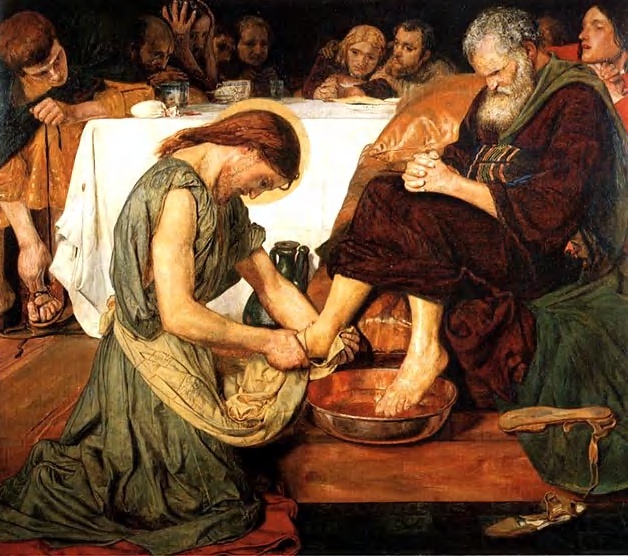
The Second Person of the Blessed Trinity was adored by angels, but He emptied Himself and was spit upon by soldiers. God Himself, Whom all creation serves, bent down and washed His Apostles’ feet. The Lord of the entire universe consented to be nailed to a tree. He Who is the source of every good thing chose to be born into abject poverty. Kenosis — self-emptying — the attitude of Jesus.
When I lived in Rome, I used to make retreats at a monastery of American Benedictine monks in Norcia, Italy, where St. Benedict was born. The first time I was there, I arrived in time for dinner and was greeted by the abbot. He approached me and said, “Have you had your hands washed?” I thought it was an odd question — I mean, I’m not five years old, I do wash my hands before dinner! So I was momentarily confused until he grabbed a bowl and pitcher and towel, and proceeded to ritually wash my hands and dry them on the towel, saying, “Welcome.” Here was the leader of the monastery, the man whom every other monk obeyed, who was willing to wash the hands of a guest. Kenosis, lived-out.
So what does this mean for us? We have ambitions and goals about many things. Perhaps we want to become an all-state football player; maybe we aim to get accepted by Harvard or Yale; perhaps we want to rise up the corporate ladder and are pining for that next promotion; maybe we are working to lose thirty pounds. Does this mean we as Christians should not desire such things?
The answer: it depends on two things.
It depends upon our motivation. Why do we want them? The sole motivation for all our goals should be for the glory of God and to better serve our neighbor. We should not hide our gifts and talents and think that we don’t deserve honors, awards, promotions, but we must ask ourselves why we are pursuing them. It shouldn’t be about our vanity, our looks, or our ego. But if you have the talents to be an all-state football player, do it for the glory of God. If you can advance in your career, do it so you can better support your family and more conscientiously take care of the employees under you. Ambition isn’t bad when it’s done for God’s glory and the service of others, but it must not be done for our own glory.
Secondly, it depends how we pursue these goals. Will you get promoted in the company because you work hard, or because you backbite and kiss-up to the boss and step on others as you climb the corporate ladder? Will you get into Harvard because you worked hard, or will you fudge the truth on your application? You may have the desire to be a sports all-star, but that does not mean we can neglect coming to Sunday Mass. We can have good goals, but they must be accomplished by keeping our integrity and our priorities in the right order.
Christ was willing to empty Himself, not exalt Himself. We may pursue our goals and achieve success, but in doing so we empty ourselves of our ego and our self-glorification. Everything we achieve should be for the glory of God. We should be truly ambitious about advancing His Kingdom and seeking our holiness. Let us and our egos decrease so that He may live and reign in us.
___
Originally published at The Cross Stands While the World Turns.
Painting: Ford Madox Brown, Jesus Washing Peter’s Feet (1852–6) / PD-US