Thanks to the great folks at Image Books, I was able to get a review copy of a The Choice of the Family: A Call to Wholeness, Abundant Life, and Enduring Happiness by Bishop Jean Laffitte, who is the head of the Pontifical Council on the Family and is tasked with preparing the regular World Meeting of Families. This is a timely book for US Catholics especially, since it can help us to prepare for the upcoming visit of Pope Francis, who will be in Philadelphia and a few other cities during the World Meeting of Families this fall. It is timely, too, because of the upcoming synod in Rome as well as the pressing concerns for the cause and meaning of the family in our contemporary cultural climate.
The book is not an academic treatise, but is structured as an interview where Bishop Laffitte is responding to questions posed to him on a wide range of topics from the meaning of the family, the role of theological anthropology in cultural debates, and even the challenges presented by Islam’s burgeoning growth in the West. Throughout the entire work, one encounters a true Son of the Church, who thinks broadly and deeply about the issues he is asked about, and always responds in charity.
Those familiar with Pope Benedict XVI’s book, Light of the World (with Peter Seeward asking the questions), will find not only a lot of material quoted from that book, but also a very similar format. Of course I wasn’t present for the questioning of Bishop Laffitte (the interviews took place several years ago), but I can imagine that Laffitte is, like George Weigel said of Pope Benedict, someone who pauses to think, then answers questions in complete paragraphs.
When I realized the book was not a treatise, but an interview, I expected a lot less substance, but I realized quite early on in the book that Laffitte’s answers provide a fairly systematic account of the family, its struggles, and its challenges. And yet the book is not a litany of problems that seem to have no answer. It is rather a sober analysis, but filled with hope and always trying to call attention to the bright spots in the world where the family really is becoming what it ought to be.
Laffittte, who received his doctorate at the John Paul II Institute and later became a faculty member and vice president of the institution, provides a lot of background on his own family situation growing up, as well as his own struggles with the faith during the tumultuous years of the 1960s. He notes his mother’s fidelity and servant’s heart in caring for a family of 12 in a time and culture in which much more burden was placed on mothers and women. Above all, he notes the seriousness of his parents’ approach to religion. When it came to the faith, his parents lived out the truth they taught, and they demanded that all of their children take seriously the claims of the Gospel and the norms it required in life.
One of the overarching themes of the book his Laffitte’s reflection on obedience, authority, and truth. Ultimately, we all need obedience to be good Catholics, but we can only learn it from someone who acts with authority and lives in accord with truth. Jesus, for instance, is always seen as one acting with authority, and that authority came from his Divine nature. For parents and families to function, there must always be a grounding in the divine order, a sacramental life imbued with prayer and a heart of love and mercy.
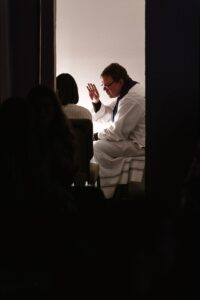
Two sections of the work stand out, in my mind, as particularly illuminating for our contemporary culture. One is his discussion of the problem of marriage preparation, with all its many issues: cohabitation, pre-marital sexual union, divorce, etc. He discusses marriage preparation with a true pastor’s heart, and without running away from the difficulties. He knows that deep in the human heart, the desire for love is always forever, and never merely “as long as possible.” But often those who approach the Church for marriage walk in merely to have a nice ceremony, then immediately abandon the Eucharist again for decades. Bishop Laffitte of course cannot solve this issue alone, but I love his idea on the real heart of the matter:
“I will not carry out a formal act rapidly without taking the necessary time, nor will I content myself with merely making them sign forms of declaration of intent! Rather, I will see who is in front of me. I will want to know how they met! The priest must love people. If he does not love them, he is not a stakeholder and is indifferent to what they have lived previously. If he does love them, he will not carry out an inquisition, but he will listen to them. He can introduce them to the Christian concept of love, he prays for them and with them and leads them to pray. If he does not introduce the engaged couple into an experience of prayer, I do not know where they are headed! I find it insane that people are prepared over the course of months for the sacrament of marriage and may not even have had one occasion to pray, that nobody invites them to pray and to entrust their happiness to God, or even to ask what God wants for them! The preparation must be a spiritual event.” (p. 48-49, emphases added)
Another theme that recurs throughout the book is the emphasis on mercy and forgiveness in the family context. In the relationship of spouses with one another, and also in the raising of children, mistakes and sins are bound to surface. But, Laffitte insists, we cannot brood over these. Rather, there needs to be a real flow of mercy in the relationship:
“…in the life of men, there have to be human, anthropological rites. When people live in society, all the more strongly within the close society that is marriage, it is necessary that there be a practice of reconciliation and of the forgiveness of offenses, including light ones; that there be a culture of peace, concord, and communion. The people and youth who have never learned to ask for forgiveness will never be disposed to pardon each other. When a difficulty arises, it will be easiest to go completely overboard. Forgiveness is central in the preparation for marriage. Personally, I have never conducted marriage preparation without consecrating a meeting to pardon, to reconciliation, and to the demands that they involve.” (p. 99)
Especially given both Pope Francis’ upcoming visit, the World Meeting of Families, and the Year of Mercy, I cannot think of a more appropriate and timely book for Catholics, especially those who are married or are engaged. The Choice of the Family gives a great overview of the major currents impacting the family as well as a positive vision of the possibility of holiness through the grace of marriage.
My only real criticism of the book is that I wish it had been more of a formal treatment, as Laffitte’s answers to the questions he were asked are surely only the tip of the iceberg in his knowledge.
Highly recommended.