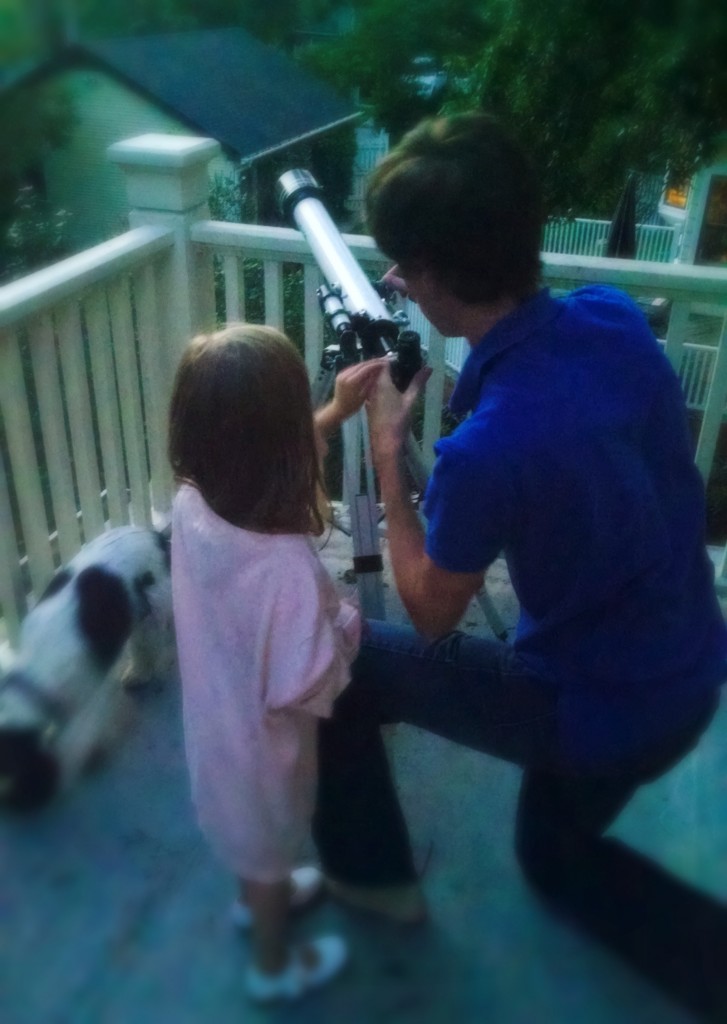
We recently visited my in-laws, and they sent us home with a treasure from my husband’s childhood – a telescope. We brought it home, and my husband spent a whole evening re-assembling it. The following night, we set up camp in our driveway and managed to see some stars, as well as Venus, Jupiter, and Saturn, through the lens. Saturn, with its distinctive rings, was particulary impressive.
In order to easily name and locate the celestial bodies we wanted to see, we downloaded an app for our smart phones. The app allowed us to span the skies, and would identify whatever we were seeing. We live just outside of an urban area, and there is a considerable amount of light pollution, so we were unfortunately limited in what we were actually able to see with our own eyes. The app told another story. As we spanned the sky, it named all sorts of stars and galaxies that we couldn’t see (because the intensity of the street lights). It even highlighted the Milky Way, showing us how it would look in the night sky in the absence of artificial lights.
It struck me as terribly ironic, that we were equipped with an impressive app and smart phones that would help us locate and name the stars, yet that same technology made it impossible to actually see them. I have visited parts of the country where the light pollution is almost non-existent, and the memory of that has always stayed with me. Unfortunately, that’s not the case where we currently live.
I am a fan of technology, and am  also aware of the fact that it has its shortcomings. The internet, computers, smartphones, are all wonderful tools, but can be distracting. We lack the focus we once had. With grace and near heroic self-discipline, we can find a balance with technology, and it can be a force for good.
However, there’s another side to technology, one that has spiritual implications. As I gazed through the lens of the telescope, and saw the tiny image of Saturn and its rings, I felt something that I don’t frequently feel. I felt a sense of awe. I was looking at something far greater than myself.
When I was a teenager, our family took a vacation to the mountains of Colorado, and I had a similar experience. Late one night, we drove out of the small town we were staying in, and stepped out of the car. The sky was incredible. There were so many stars, and there was so much light. I remember feeling overwhelmed by how small I felt, and there was something almost scary about it. One of the gifts of the Holy Spirit is “Fear of the Lord,” and in that moment, the “fear” being talked about made perfect sense. Something inside us quakes when our littleness is faced with the greatness of God’s creation. The psalmist writes,
“When I see the heavens, the work of your hands, the stars and moons that you have arranged – what is mortal man that you are mindful of him; mortal man that you should care for him?” (Psalm 8:4-5)
The greatest danger of technology lies in its ability to rob us of that sense of awe – to make us feel that we are greater than we are, more in control than we are. If you have ever stood under a night sky like the one I stood under in Colorado, you know that you are very small. If you have ever looked through the lens of a telescope and gazed at the planets, you know that there are things in creation that are much greater than yourself. And yet, it was not for the stars or planets that God became incarnate – but rather for you and me.
That realization means more when we realize how great the other aspects of creation are. We, who seem to be among the smallest and most insignificant, are the greatest in God’s eyes. It was for our sake that He took on flesh.
The temptation is to surround ourselves with light and noise to avoid that moment of feeling our littleness. Yet, without recognizing our absolute littleness, we cannot fully grasp the greatness of God’s love for us.