
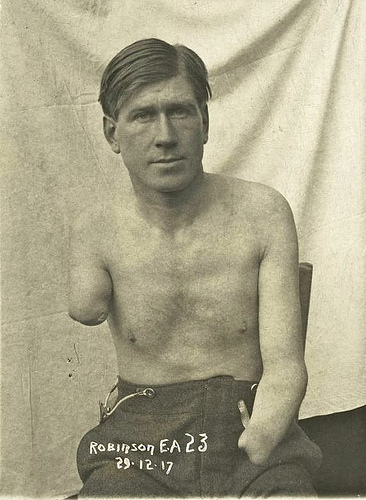
When I was 10, I caught a feature on the Discovery Channel about a young man who, after losing his arm in a motorcycle accident, felt pain where his hand used to be. It’s not that the stump hurt, but that he actually felt as if his hand, which was gone, hurt as if it was still there. When his arm came off, his hand was in a closed-fist position; the sensations he perceived were of his fingernails growing into the skin in the palm of his hand. They showed a “map” drawn by a neuroscientist of the places on the brain that control different parts of the body. This helped the doctor to determine a course of treatment to alleviate the perception of pain in the amputated arm: by stimulating facial nerves, and by cognitively focusing on “unclenching” his fist, placing his good arm in a mirror box. (Much of this I would only recall after studying cognitive neuroscience and the contributions of Vilayanur Ramachandran.)
It’s fascinating (not only because it’s an interesting phenomenon, but also because it shows what a strange child I was). Imagine losing a part of yourself and still perceiving sensations from it–an arm, a leg, a tooth, an eye, anything. You know it’s gone. Everyone knows it’s gone. It’s dead, never to come back–but it still haunts you, as if it somehow remains a part of you. This phenomenon is known as “Phantom Limb.”
The human memory works a lot like this. We have entire portions of our life–good, bad, anything in between–that, when cut off from ourselves, teem with sensations, pains, and desires. I left Austin, Texas, after three years at a university, and that entire period of my life, though gone, continues to exert phantom sensations in my desires, identity, and sense of self. It was an extremely formative period in my life, charged with difficulties, new experiences, personal mistakes, relationships, strong emotions, and eventually, at the end, a conversion to a new faith. When I decided to move back to Amarillo, it was like an amputation: that entire period had to be “cut off” in order for me to move forward.
In a curious custom, Jewish tradition prescribes a burial for severed limbs of people still alive. There is to be a customary kaddish (or, ritual burying, accompanied by mourning) for legs, arms, or appendages separated from the body. If at all possible, the appendage is to be buried with the rest of the body when a person dies. Likewise, the human memory longs for an integrity, a completeness and overarching background for one’s life. When sudden changes occur in our lives, either through our decisions or through rough circumstance, we long for continuity with our present self and our old self. If we do not mourn what we lost, we cannot put our experiences in the past and move forward.
In the Christian life and struggle for ongoing conversion, this operates on a number of levels. First, there is a human level in which our human losses–deaths, lost relationships, emotional upheavals, and the like–cries out for our attention in restoring to wholeness. Coping with loss, grieving, and the continual process of handling it are universal to the human experience. But specifically Christian is the experience of following Christ’s command, “If your right hand causes you to sin, cut it off and throw it away (Mt. 5:30).” Our ascetical practices demand that we part with those parts of our selves, those parts of our lives, and those parts of our experiences that deter our Christian discipleship. Those areas in our lives that posit real obstacles to loving others–traumatic memories, disordered attachments, hurts, regrets, resentment, selfishness, bad habits, etc.–are parts of ourselves that, through baptism and Christian conversion, are cast from ourselves, but continue to teem with perceptions that are but phantoms.
There are times in our lives when entire portions–indeed, entire “selves” we have constructed and identified with–prove diseased and rotten, and like a gangrenous limb must succumb to amputation. So much of what we think makes us ourselves, from our way of living to our personal tastes and preferences, all constitute, if not idols, then attachments that keep us from defining ourselves according to what truly matters: God’s love. And often we find ourselves longing for those things we’ve left behind for the sake of Christ, or through life circumstances.
How do we live with these phantoms? How do we live when our memories and our perceptions desire a unity that is not apparent, when in fact it seems like we’ve cut off large pieces of ourselves? I think St. John of the Cross offers us some indispensable insights into the spiritual life. Often these “phantom selves” retained by our memories, and our current desire to live the Christian life, taken together creates an impasse that we, on our own, cannot overcome. These are the moments in our live when God helps by infusing Hope into our souls–Hope being an anchoring in God’s goodness, and an expectation of receiving his promises by knowing God’s goodness. Hope is not “wishful thinking,” but a courageous act in actively, authentically choosing the joy of the Christian life. It is the will to live, the will move forward, the will to be anchored in God no matter the cost. It is through Hope that the fragmentation of ourselves that we experiences because of our memories will find healing and peace.
One of the most helpful devotions in attaining this healing is St. Igatius of Loyola’s Suscipe, offered in his Spiritual Exercises. In it, one offers one’s entire memory, will, desires, and affections to God and asks simply to be filled with God alone. This is what Hope is. This is how we ask for it. If you suffer from the phantom limbs of sorrow, anger, resentment, mourning, desire, temptations, and misplaced nostalgia for things that no longer exist in your life, or things were cast off through your baptism, this prayer is for you.
First Point. This is to recall to mind the blessings of creation and redemption, and the special favors I have received.
I will ponder with great affection how much God our Lord has done for me, and how much He has given me of what He possesses, and finally, how much, as far as He can, the same Lord desires to give Himself to me according to His divine decrees.
Then I will reflect upon myself, and consider, according to all reason and justice, what I ought to offer the Divine Majesty, that is, all I possess and myself with it. Thus, as one would who is moved by great feeling, I will make this offering of myself:
‘Receive, O Lord, all my liberty. Take my memory, my understanding, and my entire will. Whatsoever I have or hold, You have given me; I give it all back to You and surrender it wholly to be governed by your will. Give me only your love and your grace, and I am rich enough and ask for nothing more.’
(Spiritual Exercises, #234)




8 thoughts on “Phantom Limbs”
Thanks for this thoughtful piece, Nathan. I have seen in my own life how at times just removing oneself from a situation does not necessarily end the spiritual struggle but often there must be a surrender in order for healing to be achieved.
Wow, how timely. I was thinking just yesterday about the memory, and how a sense of forgiveness doesn’t necessarily come with an automatic healing of the memory–I still remember, still cringe at, things I did long in the past. It isn’t scrupulosity or a feeling that I need to go confess something, but more just a sick feeling of remembrance of sin. Getting past that memory, feeling like a whole and healed person, can be really tough when the memory of one’s past proves so resilient.
Very interesting. I am reminded that after the births of my children, I had “phantom movement” feelings after the baby came out when my brain hadnt caught up with my body that the 9 pound squirming person wasnt there anymore.
Similarly, I care for women who have had perinatal losses and they often think that a subsequent pregnancy/baby will remove all their pain from their last loss and when the memory and pain remain fresh even after a healthy new wee one arrives, they have to go back and do some of the hard grief work they may not have been ready to do earlier.
Dr. Ramachandran is featured, among several other cutting-edge neuroplasticians, on a CBC documentary called “The Nature of Things.” This episode is “The Brain That Changes Itself,” and the title is taken from Dr. Norman Doidge’s New York Times bestseller. All about neuroplasticity and the amazing things that we are learning about how the brain works. Good book to read and a good doc from the CBC.
http://www.cbc.ca/video/#/Shows/The_Nature_of_Things/1242300217
/ID=1233752028
Doidge’s book: http://www.normandoidge.com/normandoidge/MAIN.html
I’m new to VirtuousPla.net. Some good stuff here! Thanks.
God Is the source of all existence, and hence of life itself. Ergo, that which leads us away from God, leads us away from life and is contrary to our existence. Thus, we must amputate it if we are to live. I like it.
The phantom limbs thing reminds me, for some reason, of the lizard in C.S. Lewis’ “The Great Divorce.” It was the embodiment of the man’s sin, and had to be removed before he could continue to heaven. He desperately wanted it removed, and yet also desperately wanted to be spared the pain. Unfortunately, at times we can’t have both.
Good piece. Hey, is that my cell phone going off in my pocket? Wait! It’s on the counter. Hmm.
Beautiful and timely.
Excellent insight!